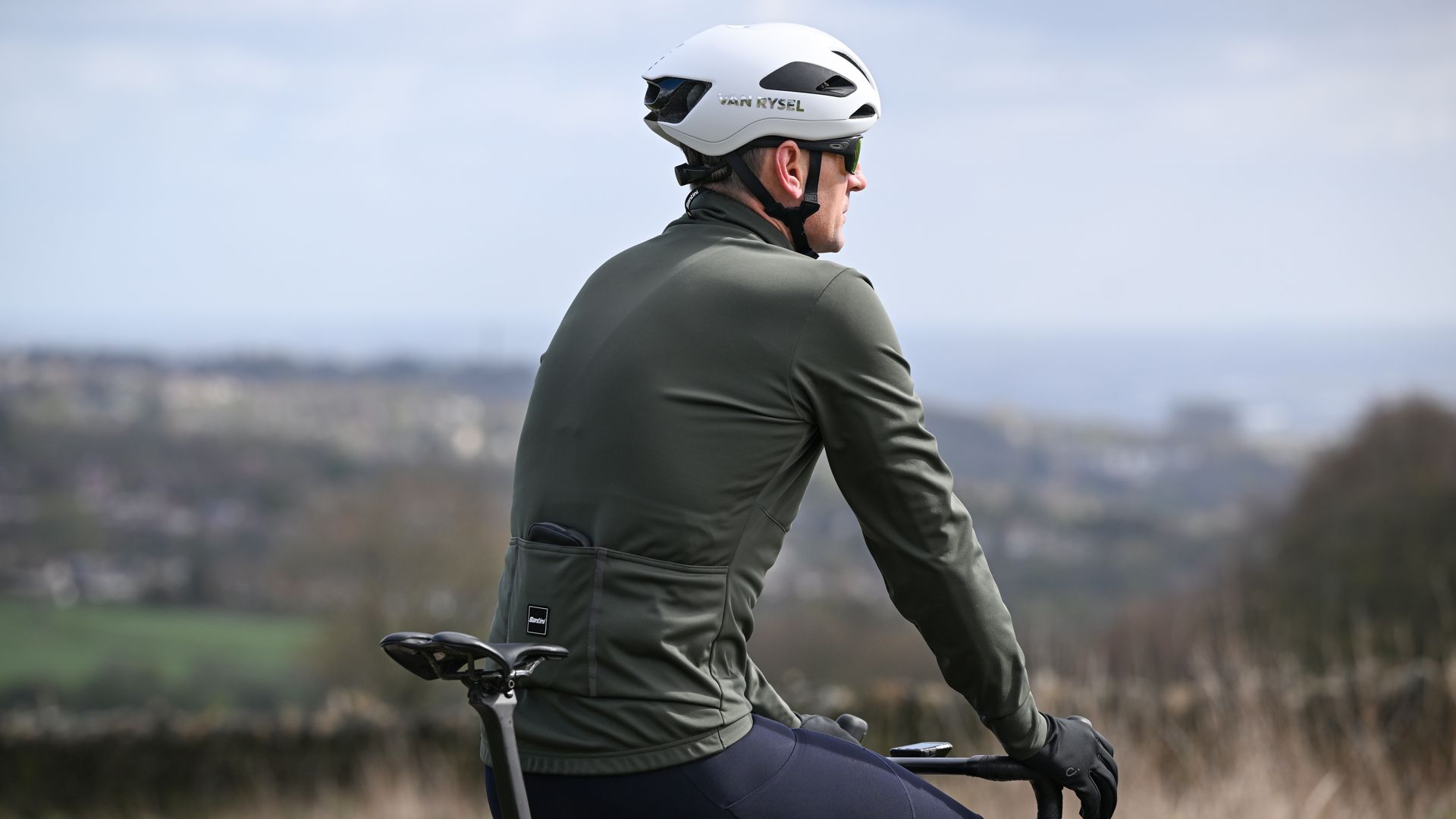
Santini Windbloc Thermo Jacket review: Protection for the coldest conditions
The combination of windproof fabric and extremely good insulation means that the Windbloc Thermo is undoubtedly very warm, but does that translate to good cold-weather performance?
If you aim to avoid the easy charms of Zwift, or just prefer year-round riding outside, then a dedicated winter jacket is essential if you want to avoid the inconvenience of multiple layers. Ideally, such a piece will be warm, breathable and comfortable as well as offering at least a degree of wind and water resistance.

Made for the coldest rides
One of Santini’s entrants in this category is the Windbloc Thermo Jacket, and with a suggested temperature rating of -8°C and +5°C, they are clearly confident that their product is, at the very least, going to be extremely warm.
Sewn inside the jacket is a motivational label with a few paragraphs detailing ‘Il Selvino’, a 10km climb in the Bergamo region, which tops out at about 1,000m. Perhaps the Windbloc Thermo has been designed for a winter ascent?
Burly is the word that springs to mind on first acquaintance with the Windbloc Thermo Jacket. The combination of fleece-lined Polartec Windbloc and the additional Polartec Alpha insulation gives the jacket a comforting, impenetrable feel that is possibly better suited to Arctic winter conditions than braving a bit of slightly chilly UK drizzle.

Polartec fabrics are used inside and out
The entire jacket is made from Windbloc, without deviation, whilst the super warm Alpha fabric has been strategically deployed on the chest and around the collar. Polartec Alpha is a superb insulation which is light, packable and very warm, but perhaps its key attribute is its breathability as the fabric used is very open and ‘fluffy’.

Superbly warm Alpha fleece lines parts of the jacket
The usual three rear pockets are all present and correct, but the Santini blurb also mentions a fourth hidden pocket, and I have to admit it took me far longer to find it than it should have done. I reckon if you weren’t specifically looking for it, you could own this jacket for years without knowing that it even existed. For the record, it’s an additional section in the right rear pocket made of very light mesh with a little flap over it. I would have much preferred an external zipped pocket.

Three decent pockets, but no zipped security pocket
A double-ended zip with substantial zipper garages allows for extra ventilation, and there are three reflective strips - two on the rear pockets and one on the left shoulder with Santini branding.
Available in XS to XXXXL for men in Green, Blue and Black, and XXS to XXXL for women in Green and Black.
I had to wait a little while after first receiving the jacket before I could wear it, as it simply wasn’t cold enough to consider going out in it. Although I’m not likely to be anywhere near my road bike at -8°C, I did get a number of rides in with the mercury at or below zero eventually, and still found it a bit too warm once I got up to temperature.
Or at least, I found it to be too sweaty.
For the first 15 minutes, it felt great, brushing off frigid winds and icy temperatures with no problem, making me feel invincible. But, without fail, after that, the moisture started to build up inside on my baselayer and not long after I was slightly damp and chilly - especially if there was any kind of stoppage for mechanicals or cafes. I invariably arrived home and stripped off the jacket and damp undergarment straight away, in stark contrast to the Velocio Alpha Air that I was using alongside the Windbloc Thermo, which was far more breathable.
Even Santini’s own waterproof Power Shield Pro All-weather Jacket was better in terms of breathability.

Perhaps a bit too warm for out-of-the-saddle efforts
In Santini’s defence, I will say that, living where I do in a particularly hilly part of the country, all my rides require a certain degree of effort, even when I’d prefer to take it easy; however, Windbloc has never been a particularly breathable fabric and a jacket made using 100% Windbloc is always going to struggle to move enough moisture outwards for optimal comfort during exercise.
Other than the breathability issues, I loved the fit and feel of the jacket. The size large fitted me well at 186cm and 73kg, with enough room for a winter base layer but not much more, with good length sleeves ensuring no annoying wrist gap. Furthermore, despite the Windbloc fabric’s robust feel, it had some stretch in it too, so the jacket never felt overly restrictive or cumbersome.
I am a big fan of keeping my neck warm, and the high, Alpha-lined collar offered plenty of protection against wind chill, almost negating the need for my beloved neck gaiter. The pockets were at a nice height and easy to access too, even trussed up in winter garb, and the overall bombproof feel genuinely encouraged me out in weather that might otherwise have had me heading to Watopia.

The Alpha-lined collar was super cosy
Whilst I like the dark green of the test jacket, and I’m sure that the alternative blue and black options are equally nice, it does seem crazy only to offer very dark colours in a piece that by design will mainly be used in less than ideal weather conditions. Granted, in Italy perhaps cold does not necessarily equal dank and gloomy, but in the UK it usually does, so a brighter option would be useful.
I was disappointed by the performance of Windbloc Thermo, not least because it felt so nice to wear and ride in up until the point that the fabric couldn’t cope with the moisture transfer.
I struggle to think of a scenario where it would be the best product to wear; maybe if you had a flat, non-strenuous commute or never exerted yourself whilst riding? But then would you really be likely to spend £200 on a jacket for riding in below-zero temperatures?
Maybe I sweat more than I think, or perhaps the weather wasn't really cold enough for the Windbloc Thermo, but it didn't perform as I would have liked.

A nice jacket let down by the outer fabric
Ultimately, I think it is a garment that has been superseded by products that use more appropriate fabrics, like the Castelli Espresso Air jacket. Blocking out all cold winds and providing excellent insulation is only really worthwhile if you don’t get wet from your own sweat, otherwise you are just shifting the problem from external to internal factors.
It is a hard one to give a rating to; on the one hand, the fit, look, feel and spec sheet are 5 star, but, in my use case at least, the performance is lacking, and certainly lagging behind the best products that I have used. Eventually, I settled on 3.5 stars, with the proviso that it isn’t recommended for any scenario that is going to see you sweating for any extended period of time. If you want fantastic weather protection and cosy warmth, then it may well be the warmest cycling jacket I’ve ever worn, perfect for descending Il Selvino, but not ideal for the tough ascent, unfortunately.