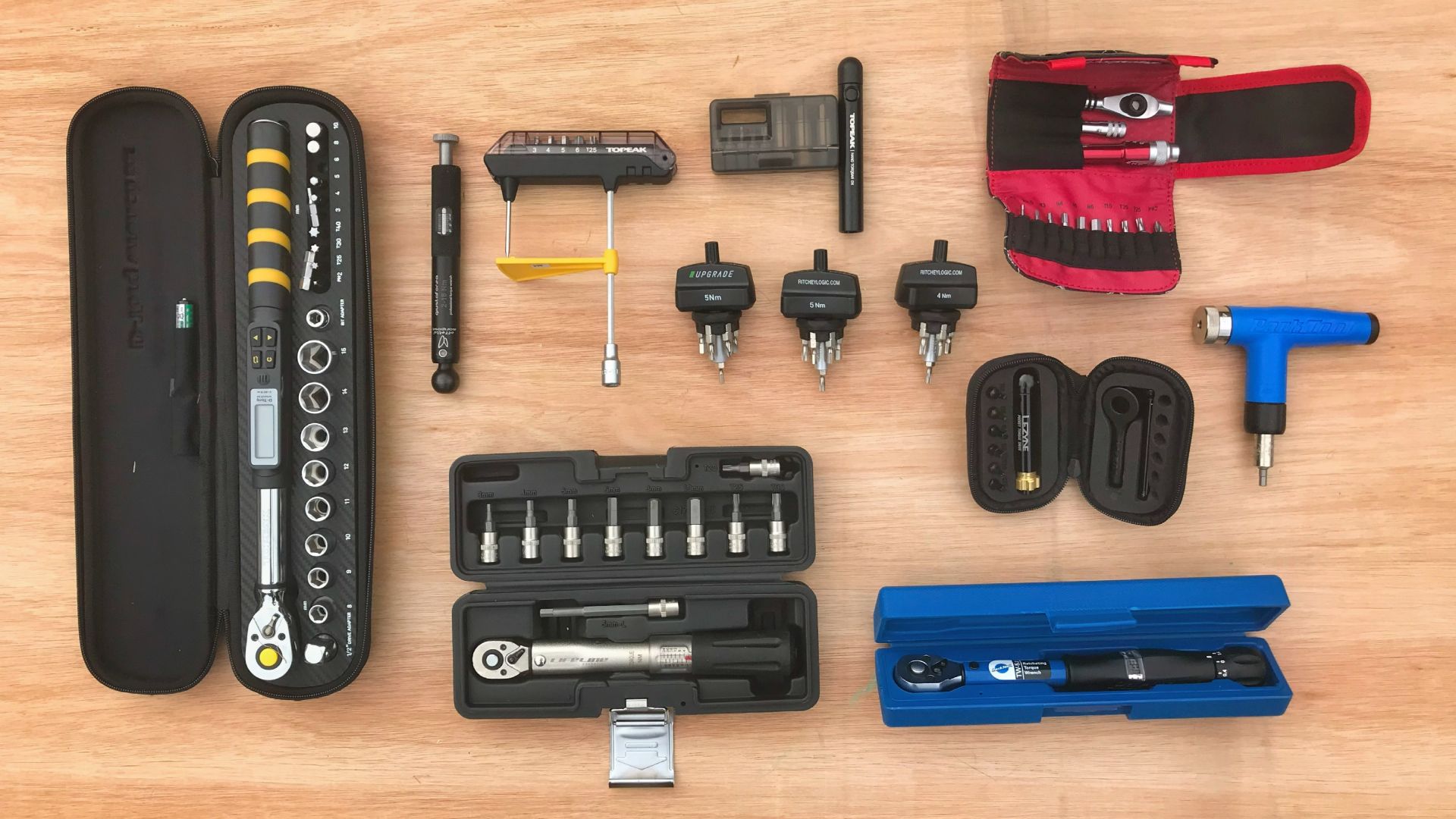
Best torque wrenches for bikes 2026: the best for portability, workshop use and simplicity
Rated and reviewed, the best torque wrenches for bikes, how and why you should be using one
While you can do basic maintenance and adjustments at home with a set of Allen keys, we highly recommend adding one of the best torque wrenches to your toolbox. All bicycle components have recommended torque values in Newton-meters (Nm) for safety, to prevent overtightening and protect expensive parts from damage.
The best torque wrenches let you follow these recommendations with high accuracy. If you judge by feel alone, it’s easy to over- or under-tighten bolts; the latter is especially true for high-torque parts like chainring bolts and bottom brackets. With a torque wrench, you can confidently fit and adjust a wide range of components, making for a safer bike overall.
Our team of experienced reviewers has put a range of torque wrenches through their paces, testing them for accuracy, ease of use, durability and more. Overall winner: the Park Tool TW5.2 for its quality, ease of use, and Park Tool support.
If you’re looking to wrench on the go as well as home, why not check out our guides to best bike multi tools and best chain tools.

Our expert review:
Reviewed by Jack Elton-Walters - Tech Contributor
If there’s such a thing as an iconic torque wrench, then the Park Tool TW5.2 is probably it. It’s been updated a few times, but it is essentially a true-and-tested design from one of the leading bike tool manufacturers. So why is it used by so many home mechanics?
I found it comfortable to use, with a well-shaped grip that lets you operate around the bike with confidence. Vitally, it’s also easy to use. To set the torque level, you simply push and twist the selector that’s positioned at the bottom of the handle; this can be done in increments of 0.4Nm and between 2-14Nm, which allows for all the accuracy and power you need for most small bolts. The torque level is also displayed on the handle and is easy and clear to read at all times.
To accommodate both standard and reverse thread bolts, the ratchet can be switched to work in either direction. Again, like the setting, this is straightforward to do.
Unfortunately, the TW5.2 doesn’t come with a set of bits, so you’ll need to factor this into your buying decision. That said, it does mean that you can just buy the bits you need for your bike or bikes. To release the bits, you just use the thumb button.

Our expert review:
Reviewed by Simon Fellows - Previous Tech Editor & Contributor
While the Park Tool wrench above is our favourite for those who are regular tinkerers, if you are more of an occasional mechanic, then you probably don’t want to spend too much on a torque wrench. Which makes the TorqWrench PRO from Prestacycle a great fit, both literally and figuratively.
At 5.25” long and weighing 68 grams, it can fit inside even the smallest of tool boxes, as well as a saddle bag or jersey pocket, should you want to take it with you on a ride.
However, its compact size belies its power and durability. It’s rated for 60Nm of total force and is good for 5,000 cycles before recalibration. It applies force via a torque-beam mechanism inside the handle, with a thumb-wheel head and a black handle at opposite ends.
I found that setting the wrench up was simple enough. The bits were inserted without issue and stayed in place. To remove them, just give them a firm tug. For reverse threads, the flick of a small switch is all that’s needed, and here it’s rated up to 60 Nm, which is great when removing stubborn pedals!
The knob-like handle is a bit fiddlier, but it’s a small gripe in what is otherwise an excellent tool. Throughout use, we’ve found it to be accurate from 2-10Nm.

Our expert review:
Reviewed by Jack Elton-Walters - Tech Contributor
If you’re looking for a torque wrench that can do it all, the D-Torq DX should be right up your alley. It offers a torque range of 4-80Nm, meaning that it can handle any bolt or fixing on your bike, including chainring bolts and bottom brackets. To further its impressive versatility, it comes with a slew of sockets, hex and torq bits and adapters.
The first thing you’ll notice when using the D-Torq is that it’s a solid piece of kit. The large handle offers increased leverage, while the tool's overall weight suggests it will be plenty durable. Certainly, during my testing, we had no complaints on this front.
A digital display makes it easy to use, allowing you to work precisely. Running on two AAA batteries, the display alerts you with a beep when you have reached your required setting. Manual display wrenches do this with a discernible click, and I found that this isn’t the case here, so you’ll need to be comfortable operating with an audible alert. Also, it’s worth noting that this beep occurs with each incremental step, too, rather than just at the end. This was a little annoying after a while, but it’s unlikely to be a dealbreaker for most.

Our expert review:
Reviewed by Jack Elton-Walters - Tech Contributor
If all you require is a single torque wrench to adjust your carbon stem or seatpost - or any of those other bolts in the 4-6Nm range - then the ATD-1.2 from Park Tools won’t let you down.
I found it easy to adjust via a dial that adjusts in 0.5 increments, while the T-shaped design makes it both comfortable to hold and effective in use. It’s also where the spare bits are stored, making it a really neat and compact design all around. Perhaps best of all, though, is the hefty click felt when you reach your number. There’s no way of missing it, which makes it really reliable.
Simple, robust and simple: a good addition to anyone’s tool kit.

Our expert review:
Reviewed by Jack Elton-Walters - Tech Contributor
If portability is your primary concern, the Lezyne Pocket wrench is worth considering. It’s the most portable wrench we’ve tested - measuring just 3.5” / 87mm, it certainly lives up to its name. Stored in its neat carry case, I found it was compact enough to fit comfortably in our saddle bag and jersey pocket.
If your bike has plenty of carbon components and you find yourself adjusting them on a ride, this wrench should be a good match. Conversely, if you primarily use your torque wrench at home, then something a little larger is likely a better match.
Because the Pocket wrench is so small, it is a tad fiddly; both the handle and the torque adjuster are detachable to enable it to pack down, but this does likely make it more susceptible to wear and tear if it is used regularly.
That said, the build quality is good, and if used for its intended purpose, namely on-the-fly adjustments, then it’s a solid option, with a range of well-made bits that should cover most tasks.

Our expert review:
Reviewed by Simon Fellows - Previous Tech Editor & Contributor
Preset wrenches are the easiest to use because they require no adjustment. Simply add the required bit and tighten until you hear the click - or in the case of the preset Pro from Prestacycle, a very solid clunk!
Aside from the great feedback that lets you tighten even the most expensive carbon bits with confidence, the tool is also comfortable in the hand, compact enough to handle those fiddly jobs, and features a magnetic shaft to keep the bits in place. You can even use it counterclockwise.
On test, I had the 4Nm wrench, but there are many others from 5Nm to 12Nm options, all good for 5000 cycles and with colour-coded handles, should you buy a few and need to distinguish between the torque values quickly.

Our expert review:
Reviewed by Simon Fellows - Previous Tech Editor & Contributor
Ok, so not a wrench, but a torque screwdriver is a really useful addition for home mechanics who have hard-to-reach bolts. There’s no ratchet here, but otherwise it proved to be really functional when a traditional wrench wasn’t, well, the best tool for the job.
Offering five settings from 2-6Nm means it can handle bars, stems, seat posts and more. To select your number, all you do is slide the scale until the desired number appears in a small window.
I was suitably impressed by the Wera 7515, particularly because the mechanism boasts a slip-over torque function, meaning it’s impossible to tighten a bolt beyond the selected value. It also works in both clockwise and counterclockwise directions, which is rare.
It doesn’t come with any bits, but Wera makes some of the most durable ones around, so we recommend buying a set to match this very handy tool.

Our expert review:
Reviewed by Jack Elton-Walters - Tech Contributor
For our money, the Effetto Mariposa Giustaforza Torque Wrench is the best-looking option around. It’s elegant to look at and feels great in the hand, with a knurled handle to ensure you don't lose your grip. Its slimline figure also means that it can reach those tucked-away bolts.
Despite its slender appearance, this is a high-quality and durable tool. It’s surprisingly weighty, which I kinda like in a tool as it suggests that it's up for the job - and I had no complaints throughout our testing. You set the torque - between 2-16Nm - with a winding mechanism at the end of the handle. I found it easy to use and accurate, too.
It’s offered with or without a set of bits. I'd suggest that if you’re spending this amount of money on a torque wrench, you might as well go all in, and I don't think you’ll be disappointed.

Our expert review:
Reviewed by Jack Elton-Walters - Tech Contributor
While the Lezyne Pocket wrench is my favoured tool to put in your saddle bag, it is pretty basic in its offerings. If you require the same level of portability but want some added functionality, then the Silca T Ratchet + Ti Torque Kit could be for you.
It comes with a neat carry case, with the tool itself comprising a handle and torque arm that can be configured in several ways depending on the bolt's location. In practice, it works, and it is a really nice feature of this tool that I found ideally suited to reaching fiddly bolts.
As we’ve come to expect with most Silca products, the overall build quality is high, with both the handle, the torque mechanism and the bits all having the appearance and feel of items that will last well. That said, there is a discernible wobble when the parts are slotted together. To date, it hasn't affected the performance of the wrench, but I'd have preferred a snugger fit.
At Cycling Weekly we have ample opportunities to test tools as most of our reviewers also are testing bikes and components that require assembly and adjustments. This means these wrench were put through their paces in a real-world environment.
We assessed them for portability, ease of use, construction and versatility as well as testing their accuracy against other wrenches for comparison. We also looked at how they feel in the hand, how positive the click is, how easy it is to set the number and read the scale, and other such details.
For more information on how the Cycling Weekly team tests the best bike tools and cycling gear, visit our How We Test page.
While Simon always likes to give fixing his bike a go, it doesn't always work out, which makes him the perfect candidate to test the best torque wrenches for bikes. Simon relies heavily on the trust torque wrench to ensure no incidents occur when maintaining his fleet of high-end road and gravel bikes.
Jack is a one-man tourist board for his beloved Isle of Wight, where he believes the best way to see the island is by bike. In between literally riding in circles around an island with less than 500miles of road, Jack likes to get stuck into bicycle tech. Jack has been one of Cycling Weekly's most frequent freelance contributors in recent years.
As this guide demonstrates, the best torque wrenches take on various guises. Given the spectrum and choice on offer, choosing the right one for you isn’t straightforward. With this in mind we’ve listed a few of the key factors you’ll want to consider when shopping for torque wrenches.
Use
Probably your first consideration when choosing a torque wrench is the amount you’ll likely use it. If you don’t spend too much time tinkering with your bike or bikes, sending it to your local bike shop for any significant servicing, and only really make adjustments when fitting new parts, say a stem or a saddle, then you’ll be able to get by with a basic model. However, if you have multiple bikes and like to do much of the repair work yourself, then it makes sense to invest in a torque wrench that is built to last. It might even be the case that you’ll require two torques, each designed for low and high torque jobs.
Range
When it comes to bicycles the torque requirements typically sit at either end of the scale. Seat posts and stems will have recommended numbers ranging from 4-6Nm, while bottom brackets and crank bolts are north of 40Nm and can be as high as 60Nm. There are torque wrenches that will cover both of these but many cycling specific models are designed to operate within a tighter range and at the lower end of the spectrum - 2-16Nm, 2-10Nm and 4-6Nm are all commonly found.
If you’re looking to work across your bike, then it could be worth investing in a long handle wrench with a high torque setting for the ‘big’ jobs that require both the power and the leverage, and a compact, low setting wrench for the ‘small’ jobs.
Preset or adjustable?
Again, if you typically work across components on your bike then you’ll need the flexibility of an adjustable wrench, However, if you’re just looking to check seat clamp and stem bolts, then a couple of preset wrenches, say 4Nm and 5Nm, are all you need.
Portability
While many torque wrenches are best suited for use in the home workshop, some are designed to be portable, often coming with a carry case which stores the wrench and the bits. These are great choices if you plan on carrying your torque wrench in a saddle bag, or if you regularly take trips with your bike and bring with it a set of portable tools.
Price
In this guide we’ve featured torque wrenches at various price points, proof that there is likely a suitable wrench for most budgets. Small, preset wrenches typically are the cheapest option and are ideally suited to those who will use the wrench sparingly. More expensive wrenches tend to be more durable and are designed for regular use in a home workshop setting.
A torque wrench is a tool used to tighten bolts to the correct level of tension. Tightness – or torque – is measured in Newton Metres (Nm), and most bike components have the appropriate level of torque expressed somewhere near the bolt. If not, they can often be found in installation and maintenance instructions on component and bike brands' sites.
It’s a good idea.
Not using a torque wrench puts you at risk of a bolt snapping, or indeed a delicate, carbon component giving way or being crushed under too much pressure. In the case of a handlebar or seastpost this can be dangerous, and if it’s proven that you’d overtightened a bolt and caused the fracture then your chances of a warranty claim could be voided.
Some at-home-mechanics might skip the torque wrench, in favor of adjusting bolts ‘on feel’. When you’ve tightened a lot of bolts, you’ll have a good idea of what 4Nm and 6Nm might feel like.
However, estimating torque can be a risky business and if it goes wrong, you’ve not got much hope of a warranty swap.
There are many different torque wrench styles – the basic option being a ‘beam torque wrench’ which measures flex in materials, and the top end choice being the electronic torque wrench which can be pre-set to a desired level and provides a downloadable history (handy evidence of due care).
The two most common styles used on bikes are 'click torque wrenches' and 'preset torque wrenches'.
A preset torque wrench looks much like a normal Allen key, with a handle. It will tighten the bolt to the ideal tension. These are light and easy to transport, as well as being highly accurate since they can’t be adjusted.
A click torque wrench often comes as part of a ratchet and socket set. These come with assorted bit ends, and the user selects the correct size piece and then sets the required torque level (often using a dial on the handle). The unit will make a ‘click’ noise when the correct torque is reached.
Having preset torque wrenches in 4-6Nm (the common tensions used on bikes) is a good idea. However, you’d be hard-pressed to have one for every ideal torque in the correct size, and they usually stop at around 10Nm – hence why you might need a click torque wrench if you’re doing more than just adjusting your saddle height.
Obviously you want enough heads for all the bolts you might want to tackle. Many small bolts on bikes are 4mm hex, but T25 Torq bolts are increasingly popular as a replacement.
There's an array of different alternative bolt sizes used in headsets and stems, particularly proprietary designs, while things like chainset bolts tend to be a different size again.
It's worth checking if the torque wrench you're looking at can be adjusted to provide the required torque in an anti-clockwise as well as the usual clockwise direction. Anything with a left-handed thread (pedals, bottom brackets) will require this and it's not necessarily standard in all industries.
In fact, using many torque wrenches 'the wrong way' can damage their mechanism and stop them from accurately gauging the level of torque. If the tool you've got does not do reverse thread, don't try and use it for reverse thread (or for loosening bolts).
Also, check that there's enough range for the jobs you expect to do. Most bike bolts need fairly low torque values, often around 5Nm and usually less than 10Nm, whereas if you're planning to tackle threaded bottom brackets, pedals and power meters you will probably need around 40Nm, which can be beyond the range of many torque wrenches intended for more delicate jobs. You probably don't want to have to buy two adjustable wrenches.