Best cycling shoes 2026: Our experts' top-rated based on their comfort, performance and style
Our experts have selected the best shoes for road cycling to make your rides more comfortable, more efficient, more enjoyable, and, of course, add a little style
There are plenty of ways to save some cash on cycling, but it shouldn't be on the best cycling shoes. Let me explain!
As a general rule, the more you spend on cycling shoes, the more performance-oriented they become. However, everyone’s feet are different, and fit and comfort should take precedence when choosing the best road cycling shoes. As one of the three critical contact points with your bike, poorly fitted shoes can be arguably more critical than the pedals themselves, preventing efficient power transfer to your best road bike pedals and hindering your forward motion.
Occasionally, that means shelling out a little more, since cheap shoes aren't cheap if they are uncomfortable and need replacing sooner rather than later. That said, you don't have to part with a fortune for an excellent pair of the best budget cycling shoes, and we even spotlight a pair or two here. On the flip side, the most expensive shoes won't necessarily be the best or most comfortable. That's why balance is key, and why we selected the Giro Imperial All-Season as our best overall. Giro really has set a new benchmark, delivering high levels of comfort, performance and weather resistance.

Our expert review:
Reviewed by Aaron Borrill - Tech Writer
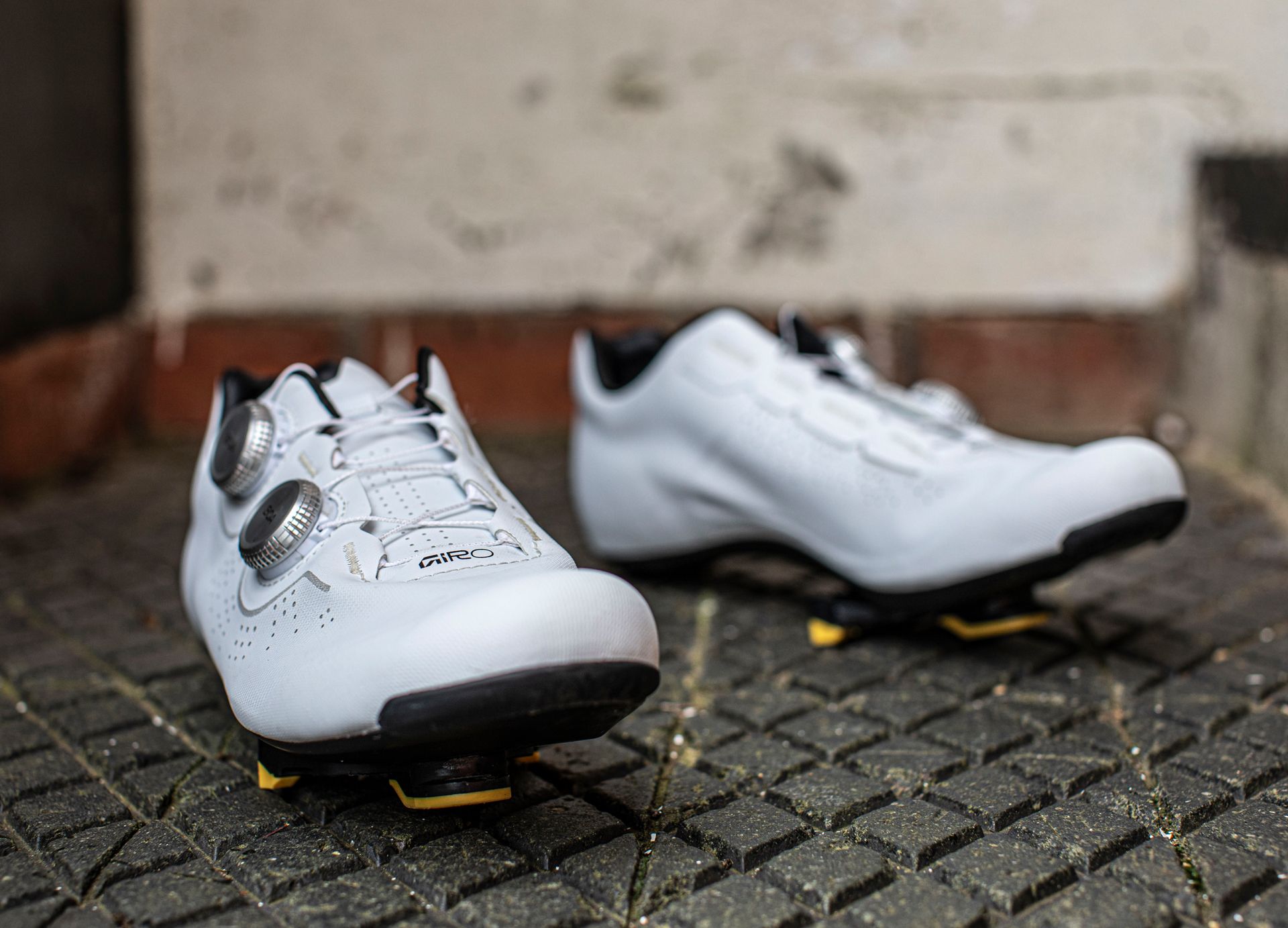
I’ve always been a fan of Giro’s shoe portfolio and have used an array of models over the years. I must admit, White shoes have never really appealed to me, largely because, since moving to the UK in 2019, the idea of the harsh winters didn’t make sense to me — until now!
The Giro Imperial AS isn’t an entirely new design, largely utilising the blueprint of the regular Imperial II, which my colleague Logan rated at 4.5 stars out of 5. That gets you a forged carbon-fibre sole and a pair of Boa Li2 dials. The difference comes in the dual-layered upper, which utilises a warp-knitted mesh and 0.25mm TPU skin, balancing ventilation with claimed weather resistance.
After two months and 1,200km in heat, cold, and rain across a trip to Spain and the UK, I reckon Giro has created the ultimate all-season white shoe and undeniably one of the best shoes I’ve used during the shoulder seasons. With wide feet, I struggle to find shoes that fit me well, but the Imperial AS has some flex in the TPU skin and a roomy toe box that conforms and provides good comfort. The Boa Li2 dials, particularly the crossed-lacing pattern, also play a big part in this comfort.
They are by no means immune to marking, especially in white, but most scuffs did wipe off. The only place where the shoes are marked heavily is on the tongue, but this is to be expected from a Boa-equipped shoe. Neither the cheapest nor the most expensive option is the best in the cycling shoe space. Very few offer the same weather- and dirt-proofing materials for use in most conditions. Giro has answered the cries of the all-weather cyclist with this excellent shoe.
Read Aaron's full Giro Imperial II All-Season shoe review

Our expert review:
Reviewed by Hannah Bussey - Tech Writer
On test, the Shimano SH-RC102 road shoes proved an excellent value, particularly for long, hilly rides. They offer a great balance of comfort and stability thanks to the glass fibre/nylon sole, which prevents the numbness that can build up when riding in ultra-stiff shoes.
Putting the shoes through their paces on a challenging, undulating 100km/60-mile ride in 30°C heat, they aren't nearly as ventilated as the Fizik Vento Powerstrap Aeroweaves, but the three-strap Velcro system was a blessing for adjusting the fit as feet swelled.
We think these offer excellent value and are the best overall budget cycling shoes, even though the Velcro closure won't last as long as a Boa dial.
They might be too flexible for sprinters, but for anyone who seeks comfort and, thanks to detailed cleat markings, is swift to set up, a detail often overlooked at this price point. They're a great choice if you prioritise comfort and value over raw performance.
Read Hannah's full Shimano SH-RC102 road cycling shoes review

Our expert review:
Reviewed by Tim Russon - Tech Contributor
It's a rare and beautiful thing to instantly click with a product. However, before I’d even reached the end of my street, the RCRs and I were going to get along marvellously.
A thousand kilometres later, and I still love them.
I suppose I should try and be a little more objective and informative, but, spoiler alert, I am already positive that these will make it into my annual ‘Gear of the Year’ list.
The sole’s stiffness was noticeable when pedalling, especially out of the saddle, and provided nice power transfer and a good, stable platform. Recently I’ve ridden in Sidi Ergo 6s, Quoc Mono IIs and even some older S-Works, and I think that the RCRs stand up to all of them in terms of stiffness. That stiffness is all the more impressive given the large ventilation holes in the soles, which are very pleasant on hot days.
Stiffness isn't everything; luckily, the RCRs were the perfect match for my foot shape, which is low volume and maybe a little narrower than average. The double habu/Boa dials let me tighten the instep and forefoot without too much tightness at the ankle, and the micro-adjustment let me fine-tune throughout the day as my feet swelled.
I guess I ought to pick out a few negatives. At 612g, they are maybe a little portly for a range-topping pro shoe (though not for their price peers), and the white upper requires some care to keep it looking its best.
Read Tim's full Van Rysel RCR-R Cycling Shoes review

Our expert review:
Reviewed by Simon Fellows - Previous Tech Editor, now contributor
The Fizik Vento Powerstrap Aeroweave is an exceptionally lightweight, stiff, and highly breathable cycling shoe. During testing, we found it perfect for hot weather and indoor riding, thanks to the open-weave Aeroweave upper that offers a very comfortable fit.
Combined with an extremely rigid R3 carbon sole featuring two large vents to maximise airflow and keep feet cool, it weighs just 368 grams (12.98 oz) in a size 40.5 (11.5), making it a serious contender against the S-Works Torch shoes as a sprinter's choice for stiffness.
The Velcro Powerstrap closure system enables impressive ventilation while providing a secure foot hold, making these an excellent option for indoor FTP tests.
This high level of ventilation, however, makes these unsuitable for cooler temperatures (discomfort below 20°C or 68°F). But priced at £334.99 ($419.99), it's just not quite as versatile as the Specialized for varied or mild weather.
Read Simon's full Fizik Vento Powerstrap Aeroweave review

Our expert review:
The Quoc M Pro Lace shoes, like the Giro, are built on a similar foundation to other shoes in the Cuoc range, in this case, the M3 Pro and Air shoes. Given how highly we rate those shoes, this boded well for my testing.
Featuring a unidirectional carbon fibre, with a toe-guard, replaceable heel pad, 3-bolt cleat pattern, and additionally two small vent holes. The big change is to the upper, which is still a TPU-laminated mesh, but now with a tongue to accommodate the laces, reducing weight and improving aerodynamics.
I’m a fan of the Quoc M shoe last, with its roomy toe box and similar in design to the Specialized S-Works 7 shoes, which happen to fit me rather well, too. Fit is always subjective, but a supportive heel, a good level of arch support, and a toe box that is more accommodating than most is a good start for anyone.
A stiff sole is only part of the system stiffness equation, though—the upper and retention system need to match the sole. With the Quoc M Pro, I did find my foot move a minuscule amount during the hardest sprint efforts, but aside from that, the support is exceptional. Even at very low cadence and consecutive long days on the pedals, they stayed comfortable.
They are, of course, by no means cheap, but for a top-end performance road shoe, they offer decent value. I do wish there were more size options available, though.
Read Andy's full Quoc M Pro Lace Up Shoe Review

Our expert review:
Reviewed by Andy Turner - Tech Contributor
The Ultimate Glide are the Italian brand's most expensive offering, likely one of the priciest road shoes you can buy full stop. But is it worth it? Honestly, these are some of the best shoes I have had the privilege of testing for performance. I would absolutely consider them if I were still racing at the level I once was, and maybe a sponsor to help stomach the cost.
At just 185g per shoe in a 45 and 368g for the pair, there are few lighter, especially dial-equipped. There are a few stiffer, as you would also expect. It is tough when talking about something so high-end and high-performance not to be whisked off your feet with superlatives that inevitably and almost too easily roll off the tongue.
So, let's discuss why the Nimbl isn’t quite a 5-star shoe, aside from the price, of course. Unfortunately, the glides lack any meaningful ventilation, lets it down. There are zero vent holes in the sole to keep things as stiff as possible, and while there are perforations on the upper, these can be considered a token gesture. For a high-performance shoe, this feels like a swing-and-a-miss; on the other hand, understandable. The all-out pursuit is admirable, but given how relentless the shoes are, this comfort feature would have gone a long way.
Read Andy's full Nimbl Ultimate Glide shoe review
Cycling Weekly's team of testers has extensive experience in assessing and writing unbiased reviews of a wide range of cycling products. Since it all involves riding, shoes are central to this, and we've tested literally hundreds of different pairs.
We have testers with large feet, small feet, narrow feet and wide feet, so you can be sure that we've taken account of the differences in fit and foot comfort for a wide range of riders and understand what makes for a good pair of cycling shoes. Where possible, we also try to make sure that more than one of our testers gets a chance to try the shoes on, so we have multiple perspectives.
But how do we put the best cycling shoes through their paces?
It all starts with the fit, cleat fitting and initial setup. As no two people's feet are the same, shoes must be tested by someone who can actually test their performance. It is rare, but if a shoe doesn't suit your feet, we won't be able to offer an objective perspective on its overall performance.
The second step, our reviewers will be putting in the miles. Shoes take a while to bed in and almost certainly need some cleat adjustment, etc.
We will next be looking to isolate performance metrics like testing for the stiffness with some sprint intervals and steep climbs. If the reviewer uses one of the best power meters they will be able to put a number to this test. Compliance and comfort are certainly more subjective points for most, as there may be any numbness or hot spots that creep in during their riding.
Depending on how long the shoes are on test, it is sometimes difficult to offer long-term durability or wear issues during testing. However, if the tester continues to use the shoes beyond the test period, they will update any review with a three or twelve-month update.
For more information on how Cycling Weekly tackles testing the world's best cycling gear, visit our how we test page.
Aaron wears a EU43/US M 10, and requires a wide fit shoe
Aaron is Cycling Weekly's tech writer; however, he is a former editor of off-roadcc, tech editor of Cyclingnews and Bike Perfect, digital editor of Bicycling magazine and associate editor of TopCar. He's travelled the world writing about bikes and anything with wheels for the past 20 years - he’s tested thousands of bikes spanning road, gravel, mountain and TT and is an accomplished racer, completing stage races such as the Cape Epic and Gravel Burn. As well as represented South Africa at the UCI Gran Fondo World Championships Road Race and Time Trial, and is an accomplished eSports racer, too - having captained South Africa at the 2022, 2023 and 2024 UCI Cycling eSports World Championships.
Hannah Wears a size EU42/US W 8.5
Hannah is the longest serving member of Cycling Weekly team having been with the team since 2011. In that 15 years she has seen cycling change drastically, not only from a reviewers point of view but by actually being part of that change herself. Having been a racer herself and now a slightly more casual ride, I say 'slightly', Hannah gets were performance works but also now enjoys a little more comfort.
Andy wears a EU45/US M 12 and has a slightly wider-than-regular fit; he most often wears a regular fit with custom insoles.
Andy is the man to know. From Aerodynamics to training and tech, Andy understands it all, and if he doesn't, he has the means to learn more whether thats through his time in a wind tunnel or his coaching buisness. He is also a prolific rider, which helps significantly, and he never asks anyone to do anything he wouldn't do himself.

Beyond the obvious shoe size, there's a lot to think about when choosing cycling shoes. Even sizing isn't straightforward, as you want a cycling shoe to hold your foot steady to pedal efficiently, so you might need a shoe that's a half size down from your normal.
Carbon soles will be stiffer and increase pedalling efficiency, which is great unless you're expecting to walk in them when a little more give will prove useful. Likewise, they don't have any sole grip.
You also need to make sure that you have the correct cleat holes in the sole for your intended pedal system; either two or three (or sometimes four for Speedplay cleats).
Think too about the closure system. BOA dials are efficient but expensive and single dials may not distribute pressure as evenly as dual dial systems. Ratchets and Velcro are cheaper and can be as efficient. Laces look smart and save weight, but you can't adjust them while riding.
A highly ventilated pair of cycling shoes or shoes with woven uppers will keep your feet cooler in hot conditions, but won't be so good if it's cold and damp.
Finally, there's the price: how much are you prepared to spend? There's no substitute for trying before you buy.
Cycling is a forefoot sport. Whilst the foot itself doesn’t generate any power, all of the watts produced elsewhere pass through your feet. So not only do poorly fitting shoes create pain, but they can also limit performance.
A former British Cycling physiotherapist and bike fitter at the eponymous Phil Burt Innovation, Phil Burt told us: “If you’re in a wrongly fitted shoe it would manifest as rubbing around the little toe, pain underneath the first and second toe where a lot of people get numbness or pins and needles.”
Touching on the performance element, he added: “The foot and ankle don’t generate any power. All the power comes from your quad and your glute. But you can lose a hell of a lot through badly fitting shoes – for example, if your foot is moving around or over pronating, you can waste a lot of energy.”
The key variables when it comes to cycling shoes are the fastening system, the sole, the cleat style, and of course the fit, although that does depend on whether you've teamed with a pair of good cycling socks.
There are basically four different systems used to tighten cycling shoes: Velcro, ratchets, laces, and dials.
Almost all budget cycling shoes use Velcro straps for fastening, basically because it's a cheaper option. For the rider, Velcro straps do a good job of holding the shoe firmly in place but can be difficult to adjust on the move and it can also be a little tricky to get the precise fit you might want.
The other benefit of Velcro straps is that they are light. This means that they can also be found on very expensive lightweight shoes designed specifically for climbers. Over time, the Velcro can lose its effectiveness though, so that the hold on your foot can diminish.
The next step up in the fastening system food chain is ratchets, so look out for some of the great cycling shoes that offer these at a lower price point. A ratchet offers more precise adjustability than Velcro straps, gives a really secure fit, and can also easily be tightened while riding. However, loosening a ratchet is not quite as easy, often requiring two hands. Ratchets are generally found on mid-price shoes and are usually combined with a Velcro strap or two further down the shoe.
At the top of the tree, you have dial closures, the fastening system used on most high-end shoes. In general, these are very secure, are easy to adjust, and can be dialed in (excuse the pun) to give a very precise hold. However, there are differences between different brands of dials. BOA dials offer the current gold standard with higher-end BOAs providing incremental tightening and loosening, while those from other brands and lower-spec BOAs can't always be loosened quite so easily.
The other option on a few other high-end shoes such as the Giro Empires and Specialized S-Works Sub 6 shoes (as well as a few retro-style shoes) is laces. For those interested in marginal gains, laces are very aerodynamic but are also generally very comfy as there's a wider distribution of pressure across the top of the foot and the laces self-adjust to help even it out. However, of course, laces are nigh-on impossible to adjust on the move.

Boa dials offer precise fine-tuning of fit
Stack height is the distance between the foot and bottom of the shoe. Thinner soles allow you to sit closer to the pedals, keeping body mass compact which helps with aerodynamics and efficiency. Thinner soles also transfer energy through the pedals more effectively. If performance is your aim, thin soles are what you want.
As with the fastening systems, different types of soles come on different cycling shoes, and of course the more you pay, the more you get.
The main thing that you are looking for with the soles of your cycling shoes is for them to be stiff. This means that when you press down the sole won't bend, meaning that all of the power that you generate is transferred through the sole and into the pedal. The second consideration is weight, with more expensive shoes coming with lighter soles.
Entry-level cycling shoes will generally come with nylon soles, but if you pay a bit more you will get shoes with carbon composite soles (i.e. a mixture of carbon and plastic), while at the top of the scale, you will find carbon-soled shoes. The only thing with some high-end shoes is that some people will find that the ultra-stiff sole may cause discomfort on longer rides, so it's worth reading some reviews before parting with your cash.
As ever, weight is also important, with top-of-the-range carbon shoes often being much lighter than entry-level models.

Most road cycling shoes are designed to fit three bolt cleats only
While you're looking at the material of the soles of your prospective new cycling shoes, it's worth looking at the type of cleats that they will accommodate, as some will take two-bolt cleats while others will take three-bolt cleats. Some, particularly lower-priced models, let you fit either. Your choice really depends on what type of riding you're doing.
If you're riding off-road or want to have a pair of shoes that are easy to walk in, then go for a pedal system that uses two-bolt cleats such as Shimano SPDs or Crankbrothers Eggbeaters.
However, for most road riding, you want three-bolt cleats which will give you a wider platform for improved power transfer through the pedals. For that reason, mid and high-end shoes will only come with a three bolt pattern.
Even if you're riding in warm, dry conditions, your cycling shoes are likely to get sweaty inside. Once you take them off, don't just leave them sitting in a plastic bag, but put them somewhere dry where they can air and dry out. It's a good idea to pull out your insoles too, to make sure that the inside of the sole unit dries out fully. Many more expensive cycling shoes may come with a net storage bag to keep them in.
If your shoes get wet, you should take out the insoles and pack the inside of the shoes with scrunched-up newspaper to help soak up the moisture.
Most cycling shoes can be wiped down with a damp cloth, but don't try anything more aggressive to clean them unless the maker's care instructions advise this.
If you're regularly riding in poor conditions, a pair of the best cycling overshoes will help keep your shoes clean. Overshoes tend to wear quickly though; a dedicated pair of winter cycling shoes like the Gaerne Icestorm boots might be a better bet for bad weather. They will have a fully enclosed, waterproof upper and sole, usually with a breathable membrane and insulation, to help keep your feet dry and warm.
Heel support and heel lift are often an issue with this type of winter boot though, so make sure that the fit is good if you go this route with space for some warm socks. Also, consider swapping to winter boots and pedals with two-bolt cleats for their better walkability in the wet or when it's icy so that you're less likely to take a spill on a tile floor at the coffee stop.
When brands create cycling shoes, they will typically cater for the “average” individual to accommodate the largest segment of the market. However, with cycling shoes being both incredibly rigid and fixed in place via cleats and pedals, those who fall outside the norm can struggle to find shoes that fit.
Several brands offer ‘wide fit’ options, including Sidi, Bont, Shimano, and Lake. Lake did feature in this guide until recently with the Lake CX403, however, given most brands offer a wide varient or similar, and Lake now offers the more up to date CX333 which are yet to test, its worth checking out thier ranage as it provides wide toe boxes as well as custom molded heel cups to ensure a good fit all round for those with a wide forefoot and narrow ankle.
We’ve had one wide-footed tester - Cycling Weekly's Owen Rogers, put three pairs of the best cycling shoes for wide feet through their paces. However, former British Cycling physio Phil Burt advises that those looking to solve foot pain ensure they’re solving the correct problem before purchasing.
“You may not have wide feet. It could be that your foot is collapsing and, therefore, splaying. A lot of people think they have wide feet, but given an off-the-shelf corrective insole, the problem goes away because they have the support their foot needs.”
You can buy arch-supporting insoles from your local chemist, and of course, there are many brands out there that will create you a custom version should you want something more bespoke.
If you're sure you do have wide feet and do not need an insole, then read on.
Triathlon shoes are different from road shoes. If you fancy the idea of doing some triathlons, it might be worth getting a triathlon-specific pair.
Tri shoes are designed to be put on and off quickly while cycling and consequently use an easy-to-open retention system. They often feature a loop on the heel that you can grab for easier access. However, if you ride in cold weather, be aware that tri-shoes often also feature drainage holes and mesh for wet feet so they don't offer much insulation from the cold. If you want road shoes and not triathlon shoes, be sure to check with the retailer that you're getting what you want.
Cycling shoes, even pricey ones, often come with fairly basic flat insoles. Since your feet are held in a static position, this can cause discomfort over time. It's worth considering an insole upgrade. Some aftermarket insoles will have an adjustable level of arch support, most will be made of more substantial material than the insoles that come with your shoes and often there will be other extra features like a less flat profile and a midfoot bump to help support your feet better. You can also buy bespoke insoles made to match your feet.
There are a number of different shoes on the market such as the Bont Riot and the Lake CX402 that can be customized through heat molding to fit the shape of your feet. This means that the shoes should perfectly support the arch of your foot, ensuring that you should be very comfortable and power transfer should be improved too as your foot won't move around at all. If you have flat feet or arch-related problems, heat moldable shoes could be the solution.
The best way to check the fit of a shoe is to try it on in your local bike shop before purchasing (hopefully you'll make the purchase in the shop too!). It is better to do this in the afternoon or evening as your feet can expand slightly during the day.
Shoe sizing is pretty consistent across brands, particularly when compared to other pieces of cycling clothing – but just because your old and worn-out size 46 shoes were comfortable, it doesn't necessarily mean you can jump straight into a different brand in the same size.
Arch heights, shoe widths, and different fastening systems can all mean that you may find yourself going a size up or down when buying new cycling shoes. Flashier shoes usually come in half sizes, so you can get a good match for your feet. Lower-priced shoes, however, tend to be sold in whole sizes only - they are usually more roomy to start with as well. If your feet are between sizes, that can make choosing the right size tricky. If you're not sure, we'd suggest sizing down.