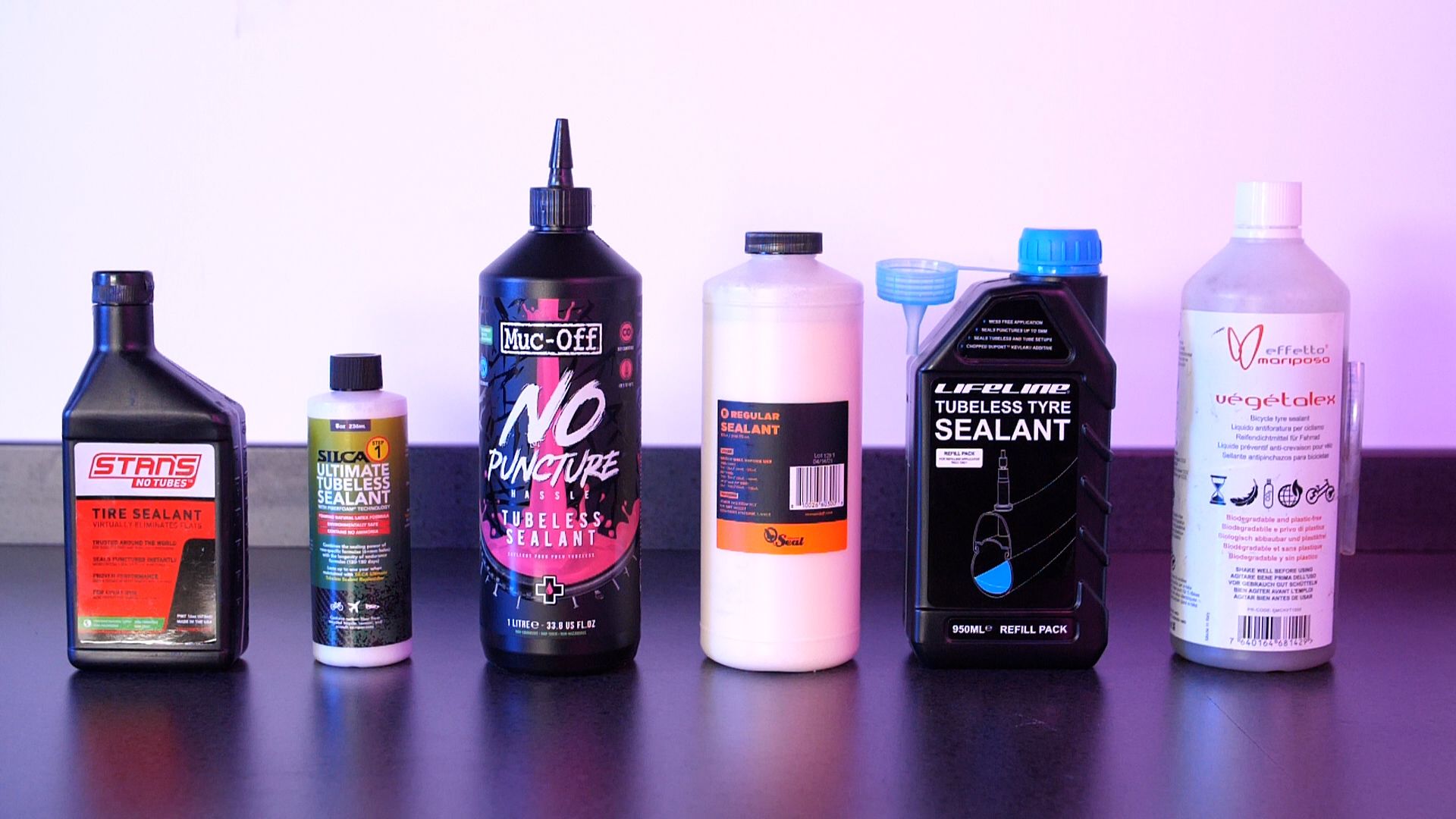
Tubeless sealant is engineered to prevent flats and seal punctures, so I put it to the test. Which of these five seals the biggest hole?
Fitting any tubeless tyre requires one of the best tubeless sealants to ensure a good seal, prevent air loss, and protect against future punctures. Running a tubeless setup is now the norm, even in the WorldTour peloton, with clear, proven benefits to ditching tubes.
I pitched five popular sealants against each other to determine which is best for tubeless tyres. I did this by deliberately puncturing one of the best road tubeless tyres with ever-increasing screwdriver sizes, starting at 1mm and going to 7mm, until the tyre could no longer hold 70 psi. To ensure a fair, measurable test, I used a control tyre, the popular Schwalbe Pro One 28mm, fitted to a Zipp 303s wheel, known for its high-quality seal and compatibility with a wide range of tyres.
One standout performer was the Silca Ultimate Sealant, which made me reach for an even bigger screwdriver to see how big a hole it could seal. Silca wasn't the only one to impress. At half the cost, the Muc-Off No Puncture Hassle sealed up to the same size, but failed at 30 psi, which, for wider tyres (35mm+), might get you home.
If you would like to know more about tubeless setups, check out these two articles. The first is our guide to setting up tubeless safely, and the second covers diagnosing and fixing leaky setups.
If you're still not ready to go tubeless, check out our guide to the best TPU inner tubes, which offer some of the performance of tubeless without the faff.

Silca Ultimate Tubeless Sealant
Our expert review:
Silca's Ultimate sealant launched in early 2022 and came with a raft of innovations and bold claims – notably an ability to seal punctures up to 6mm at 80psi and up to 8mm in lower pressure systems. Impressively, it lived up to the hype.
In our testing, we found that sealant was able to easily plug holes up to (and including) a 3mm diameter. On the 4.5 and 6mm diameter screwdrivers, the sealant would seal at a low pressure but the hole burst open when pumping the tyre back up to 70psi.
But on the second try pumping the tyre back up to pressure, the sealant managed to hold. It seems that after the hole reopened that first time, the 'dam' of carbon fibres around the hole was reinforced, enabling the sealant to ultimately plug the 4.5 and 6mm holes.
Going up to the 7mm screwdriver (which really is huge, larger than any nail you're likely to cycle over) the same thing happened with the hole reopening when pumped back up, but then resealing and able to handle higher pressures. It took an additional cycle over the previous two screwdrivers – but in the end, the Silca Ultimate sealant did manage to hold 70psi after being punctured with a 7mm screwdriver.
It is at the more expensive end of the sealants currently on the market – but its price is by no means an outlier. No other sealant we had on test was able to plug such a large hole and many failed on much smaller diameters.
Of course, this doesn't mean it'll definitely plug every puncture of that size every time, but it's a highly impressive line in the sand and makes this the best-performing sealant we had on test. For road tyres and pressures, we'd fully recommend it.

Muc-Off No Puncture Hassle Tyre Sealant
Our expert review:
There definitely is something about long-stranded particles that really boosts sealing performance. Although Silca has made a lot of fuss about its carbon fibres and its research, it appears that the Muc-Off sealant works in much the same way, with very similar-looking fibres visible in the plugged holes.
The Muc-Off No Puncture Hassle Tyre Sealant didn't seal quite as quickly as the Silca Ultimate sealant on the middle and larger sizes of screwdriver, but it still did the job nonetheless.
And just like the Silca sealant, it did take two tries pumping the tyre up to 70psi after being punctured with the 6mm screwdriver for the hole to be fully plugged and able to hold the pressure.
At 7mm, the hole would seal at around 30psi, but it wouldn't hold pressures any higher than that – repeatedly inflating the tyre and the seal would break every time.
Still, 6mm is a very good performance – better than any of the other sealants we tested except Silca – and especially at these higher pressures we tested at. Essentially, the Muc-Off No Puncture Hassle Tyre Sealant sits just beneath the Silca Ultimate sealant.

Orange Seal Regular Sealant
Our expert review:
Another sealant stalwart, Orange Seal is a brand with a long history. However, in this test, the results weren't superlative.
To be fair, the sealant did manage to plug holes up to and including 3mm at 70 psi, which is on par with both the Stans and Effetto Mariposa. The Orange Seal Regular sealant also plugged those smaller holes faster than the Stans No Tubes sealant was able to.
However, the claimed longevity is significantly less than all of the other sealants we tested, which stands to saddle you with increased maintenance and cost. The temperature rating also isn't as low as some of the other sealants with equal or better sealing ability.
So, in terms of the actual sealing ability the Regular sealant is in line with most of the sealants we had on test. It's the claimed temperature rating and longevity that let it down.
Orange Seal does have an Endurance sealant which is claimed to last between 2 and 4 months and a Subzero sealant which is claimed to go down to -20°F / -29°C, but both of those only claim to be able to seal punctures up to 3mm – with the Regular sealant claiming to seal up to 6mm holes.

Effetto Mariposa Végétalex Tyre Sealant
Our expert review:
Effetto Mariposa's Végétalex Tyre Sealant is quite different to anything else we've used. It's got a gloppy, almost oily, gelatinous consistency to it, which is a result of its plant-based ingredients – it's fully biodegradable and totally plastic-free.
That thicker consistency could be what gives this sealant its impressive claimed longevity. Although it states three months, Effetto is explicit that this is the minimum in the most extreme conditions – not just the lower band of what most people will experience in more 'normal' use.
But longevity wasn't what we were testing for here – so back to its puncture-sealing abilities. The sealant managed to plug the 1, 2 and 3mm screwdrivers without much of a problem.
Going up to 4.5mm, it took quite a long time for the air to finally stop leaking out and a seal to form at a (very) low pressure. When trying to pump the tyre back to pressure, the hole kept on reopening – unlike the Silca and the Muc-Off sealants, the Végétalex seal didn't seem to strengthen after being broken open.
But sealing a 3mm hole at road pressures is all that the sealant claims to be able to do, so it can't really be faulted for its performance – even if it does fail on smaller holes than some of the other sealants on test.

Stans No Tubes Tubeless Tyre Sealant
Our expert review:
Stans No Tubes tyre sealant really is a classic and perhaps one of the best-known options out there. The claims of cold weather performance are quite exceptional for this sealant – not many state that they'll go down to lows of -30°F / -34°C.
When it comes to the sealing ability on our road setup, though, the performance was a little off the mark. The sealant claims that it's good for holes up to 6mm in diameter, but presumably, that is referring to the lower pressures of an MTB or gravel system, as we found the sealant unable to plug punctures larger than 3mm at road pressures.
That said, 3mm is still a significant sized hole. It's not the pin-prick of an upturned tack, but rather it's the size of a pretty vicious nail – something you'd typically very much try and avoid, rather than simply cycling over it.
For use in milder climates, from this test we'd recommend LifeLine's sealant as it's cheaper and plugged larger holes. But in particularly cold climates, this would be our go-to choice.
During my testing, there was some disparity between the size of the hole the sealant could seal and what the manufacturer claimed. This wasn't always in favour of not meeting the claimed spec, either. In the case of the Silca and Effetto, it was actually far greater than claimed, which feels like a rarity.
So, to make this easier to understand, I have created this easy-to-read bar chart, which shows the size of the hole sealed in our screwdriver test in millimetres compared to the manufacturer's claimed size.

Chart shows in millimetres the size of the hole sealed in testing vs the claimed
Claimed to seal
Perfomance during testing
Silca
6mm
8mm
Muc-Off
6mm
6mm
Effetto Mariposa
3mm
5mm
Stans No Tubes
6mm
3mm
Orange Seal
6mm
3mm

Sealant testing
First up, let's go through the tyre and rim combo. We were using a 28mm Schwalbe Pro One tyre on a Zipp 303s rim. Like an increasing number of today's best road bike wheels, there is a pressure limit of around 70 psi.
This is a lower pressure than what early adopters of road tubeless may have been using. But considering the continuing shift to wider tyres and, of course, the growing number of brands going for a 70psi pressure limit, we thought that this made a good benchmark for our test.
We brought a total of six screwdrivers with shaft diameters of 1, 2, 3, 4.5, 5, 6 and 7mm. The process was to add 60ml of sealant and then start with the 1mm screwdriver, puncture the tyre, spin it until it seals, and then pump it back up to 70psi.

If the tyre could continue to hold 70psi after the puncturing, then the next step was to repeat with the next size up – until the tyre could no longer hold 70psi without the hole reopening.
So as not to be too wasteful, we cleaned out the tyre of sealant after each test, patched it up with a stick-on tyre boot, and went again with the next sealant. In the end, we did still end up using two tyres in total.
While Stefan has moved on to pastures new, his legacy lives on here at Cycling Weekly, as his prolific output of reviews fills our buyers' guides. Stefan favours no single category and loves nothing more than just getting out on his bike. In more recent years, along with his partner, he has taken to bikepacking, undertaking big tours, like across Budapest to Slovenia in eastern Europe.
Cycling Weekly sat down with John Vargus, founder and president of tubeless sealant maker Orange Seal, to learn his top tips for maximising the efficiency of sealants.
There's more advice on tubeless tyre set-up from an expert in our piece on tubeless tyres: are you doing it properly?
Choosing the best sealant is much simpler than it seems. Ideally, you just get the one that performs the best and seals the biggest holes. Which, from my testing, I cannot rate the Silca Ultimate higher. However, it is worth considering a few things before making a purchase.
The size of the punctures you might typically encounter depends on the pressures you ride at, which are most likely determined by whether you are on or off-road. Alongside the temperature at which you mostly ride.
Why are these things important?
Different sealants perform to varying standards depending on these factors, and it's worth tailoring your choice to suit. For example, on the road, puncture holes are likely to be smaller, and given the higher pressures, you want something that can seal quickly rather than just be expelled.
For gravel or off-road riding, there is a chance that holes will be largely from rock or tree debris, in which case you need something that can create a good, strong and reliable seal.
In my testing outside this group test, temperature is the biggest factor affecting sealants; however, it seems to have the biggest effect as the temperature drops. With the viscosity of sealants being the issue as the mercury heads towards zero. So, if you regularly ride out in the cold, such as during northern hemisphere winters, it's worth maybe using one sealant in the summer and another in winter.
The best way to think of tubeless sealant is as the lifeblood of your tubeless system. Its primary job is to plug puncture-causing holes by coagulating or, keeping the blood reference, by clotting. The best tubeless sealants form a seal that will ensure the tyre remains airtight.
They also help form an airtight seal between the wheel rim and tyre when you first mount a new tyre, so that the tyre will hold air and keep its pressure.
The exact formula for a brand’s sealant is a closely guarded secret (just as with tyre rubber compounds) but effectively they can all be split into three types – those that contain latex rubber, those that utilise a synthetic alternative, and those that make do without. Most sealants also use small particles that gather around punctures, allowing the sealant to clog and seal larger punctures.
Latex-based tubeless sealants are the most common, as natural latex rubber has very effective coagulating properties. Latex itself is an emulsion of extremely small rubber polymer particles in either water or a water-based ammonia solution.
When you get a puncture, the latex will set over time making the seal durable, so that you can continue to ride on the tyre. Most sealants also have other non-active particulates in the suspension, which act as a nucleus for the rubber to coagulate around (just like raindrops need a speck of dust to form around), increasing the size of holes the sealant can fill.
The reason for this effectiveness as a sealant is that coagulation of the latex is activated by air. So when a tyre is punctured, the dramatic release of air causes the liquid part of the sealant to evaporate, leaving behind the latex rubber particles to knit together and clog the hole.
Non-latex based tyre sealants approach the prevention of punctures from a different direction. As they contain no ingredients that coagulate in the same way as latex they have to rely on a much thicker viscosity to plug any punctures. So just pour it in and off you go?
Unfortunately due to the slightly unstable nature of all sealants, it is not a fit-and-forget solution. Over time sealant will dry out and, in the case of latex-based sealants, will coagulate into a solid lump reducing effectiveness to almost zero.
Every time you adjust tyre pressure you introduce air into the tyre, accelerating the drying process. Outside air temperature will also have a dramatic impact on life expectancy. Effective operating times are reduced as temperature goes up and for many sealants if the temperature drops below zero.
For many sealants, this means that the life expectancy is shorter than you might realise. It’s the one aspect of a tubeless setup that can catch many riders out.
How long a sealant will last depends on the conditions your bike is kept in, the sealant you've chosen, and how many punctures it'll need to plug.
In hotter and dryer conditions, sealants dry out more quickly. This can result in the sealant needing to be topped up in as little as 30 days or, on the other end of the scale, three months for some particularly hardy sealants
In cooler and wetter conditions, a minimum of three months lifespan is typical and some will last for over six months – providing you aren't puncturing the tyre so often it all leaks out before then.
If you have set your tyres up tubeless, don't assume that you'll never have to make a roadside repair. You'll almost certainly avoid those annoying stops for small punctures from thorns and road grit, but performance on larger holes in road bike tyres is still quite hit-and-miss, as this opinion piece tells.
It's a good idea to carry a pump or CO2 canister so that you can get some more pressure into your tyres. Sometimes the sealant plug just won't hold at higher pressures, so you might need to ride a soft tyre home. Leave it overnight and it will often have set enough to take full pressure though.
If you're going to be far from home and calling out the broom wagon isn't an option, carry a tubeless tyre repair tool. As a last resort, it's worth having an inner tube with you that you can swap in if all else fails, although the sealant will make this a messy business.
Make sure that the inside of the tyre is free of thorns before you pop it in though, as you may have previously accumulated debris that has penetrated the tyre wall but been dealt with by the sealant. It's worth carrying a tyre boot too, to ensure that the tube doesn't get pinched by a larger sidewall gash and itself puncture.
It's not uncommon to find that the tyre and rim create a good enough seal that actually the tyre will stay inflated without sealant. This is the recommended and cleanest way to fit a tubeless tyre, with the sealant being pushed through the valve.
The short answer is riding without sealant in your tyres is not safe. Even if you can get a good seal with just the tyre and rim, sealant does a fantastic job of getting into all those unseen places. Ultimately, it ensures there is no rapid air loss and that your tyres stay inflated.
There are a number of popular methods to fitting tubeless sealant; it really comes down to personal preference and how tight your tyre is to fit on the rim.
I prefer to pour the sealant in when I am fitting the tyre's bead onto the rim. This ensures you get the correct amount and the full mix of sealant in the tyre. However, this is by far the messiest way of doing it if the tyre doesn't play ball or, god forbid, the tyre blows off the rim during inflation.
The most popular method is using a syringe to inject the sealant through the valve with the core removed. This is the cleanest method and allows you to seat the tyre first without the risk of sealant going everywhere in an explosion. However, it is worth investing in some of the best tubeless values, as it is very easy to clog the valve this way, and it can take some patience to ensure you get the right level of sealant into the tyre.