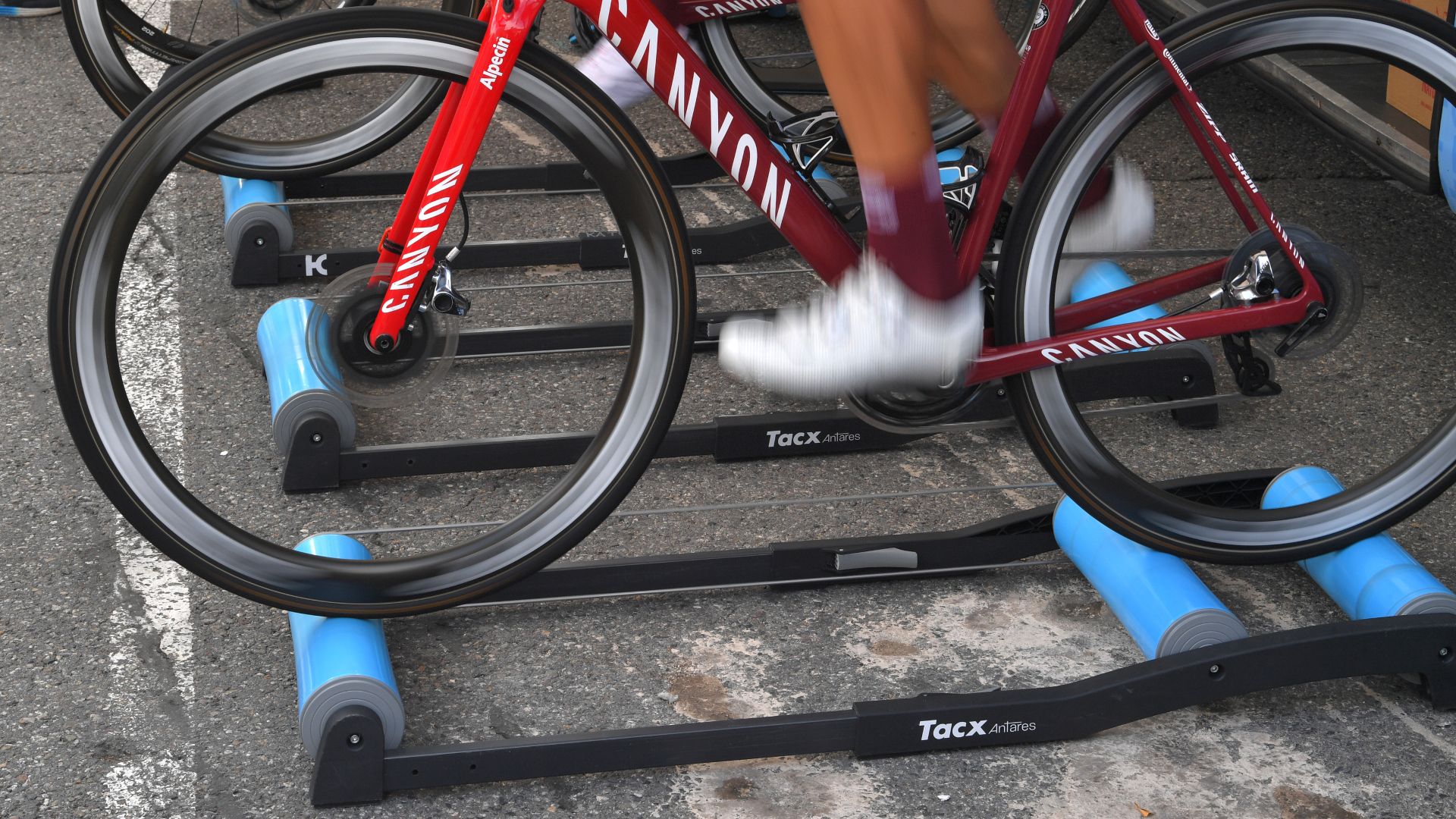
Best bike rollers: how to add variety to your indoor cycling
Our pick of the best bike rollers for those looking to break up the monotony of indoor cycling, with a little more rock and roll
The latest race content, interviews, features, reviews and expert buying guides, direct to your inbox!
You are now subscribed
Your newsletter sign-up was successful
While we now live firmly in a digital world, there are still plenty of analogue pleasures left to enjoy. Books. Vinyl records. And rollers. The best bike rollers allow you to train effectively, avoiding the worst of weather, without the expense and complication of a smart trainer.
While smart functionality can create an immersive training experience, the best bike rollers can be freeing, enabling you to focus on your balance and your pedalling style, helping to develop the skills required to ride in a bunch. Combined with their portability, there’s good reason why they have been used by the best amateur and professional racers for decades, ideally suited for a pre-race warm up or a cool down after an event.
Cycling Weekly’s experienced team of reviewers have tested a number of rollers, and we’ve selected six of the favourites here. We’ve included both smart units that deliver connectivity and traditional ‘unplugged’ trainers with the aim of helping you find the best bike rollers for you.
While rollers are typically the preserve of more experienced cyclists, we all have to start somewhere. With this in mind we have a dedicated guide to how to ride on rollers as well as the ‘how to choose’ section, which is featured at the bottom of this guide.

The Tacx Galaxia includes parabolic rollers, which help keep the bike in the centre for a more stable ride. The swing system helps to absorb any sudden accelerations and improves ride feel.

Compatible with Zwift and other training apps, the Arion Mag is light, quiet, and the parabolic rollers help keep you upright with a simulated climb of up to 5%, adding additional realism.

Hugely popular not just for its low cost of entry, but for beginners and riders lacking confidence, thanks to the Antares parabolic-shaped rollers.

If you're nervous about riding unsupported, the Wahoo Kickr Rollr anchors your bike while you ride, without hampering the roller experience.

The Elite Nero rollers tick a lot of specification boxes. Gradient simulation, rocker base, smart app connectivity and high power output make it one of the most realistic rollers to ride.

Ideal for pre-race warm-ups due to its stability and self-generated resistance, the Omnium security lowers the risk of any embarrassing moments.

The knock on rollers can be that they don’t adjust well to a change of pace. By starting to pedal harder and faster, as you would do in a sprint, the sudden movement can cause you to derail. Tacx has addressed this problem with its Galaxia model, and it’s one of the reasons we’ve selected it as the best overall model in this guide.
To help absorb any movements caused by a switching of pace, or by standing on the pedals, Tacx has equipped the Galaxia with what it calls its ‘swing system’. In essence a device at the rear of the rollers allows them to swing forwards and backwards as you accelerate, helping you to stay in place. And it works.
Stability is aided further by the use of conical rollers, which are designed to keep you and your bike centered. They work by coaxing the tyres away from the edge, which is particularly helpful for newbies who will find themselves drifting from side to side as they learn the ropes.
It’s likely that you’re looking at buying a set of rollers, in part, because of their portability. The Galaxia retracts to just 80cm and weighs 18 lbs or just over 8kg, which makes it easy to store away when not in use as well as to carry to and from races.

Pros regularly use rollers for warm-ups thanks to their ease of transportation and setup
If you like the simplicity of rollers but want to train with greater resistance as well as being able to use training apps such as Zwift, the Arion from Elite should pique your interest. In fact, we were impressed enough to name them as the best smart rollers in this guide.
By offering controllable resistance up to 1,100 watts, the Arion mimics a regular turbo trainer. It uses an electro-magnetic resistance unit to achieve this, which you need to pair with Elite’s training app. From here you simply pedal to pair the devices and then use the app to control the resistance levels.
In practice, it works well. It’s straightforward to set-up and allowed us to go through a series of intervals just as you would on a regular turbo without any unnecessary jarring movements as we upped our cadence. Similarly, on a rolling Zwift course it was just as smooth.
Connectivity comes via ANT+ and Bluetooth, and allows you to send power, speed and cadence numbers to one of the best cycling computers as well as use indoor training apps, as mentioned previously. We did find that when it came to power data, the Airon gauge was typically overoptimistic. Because of this we ended up keeping our power meter pedals hooked up to our cycling computer, with the rollers paired to the app on our phone to control the resistance.
Despite this, the ability to combine the lifelike sensation of traditional rollers with the resistance of a turbo trainer, makes using the Arion an enjoyable experience.
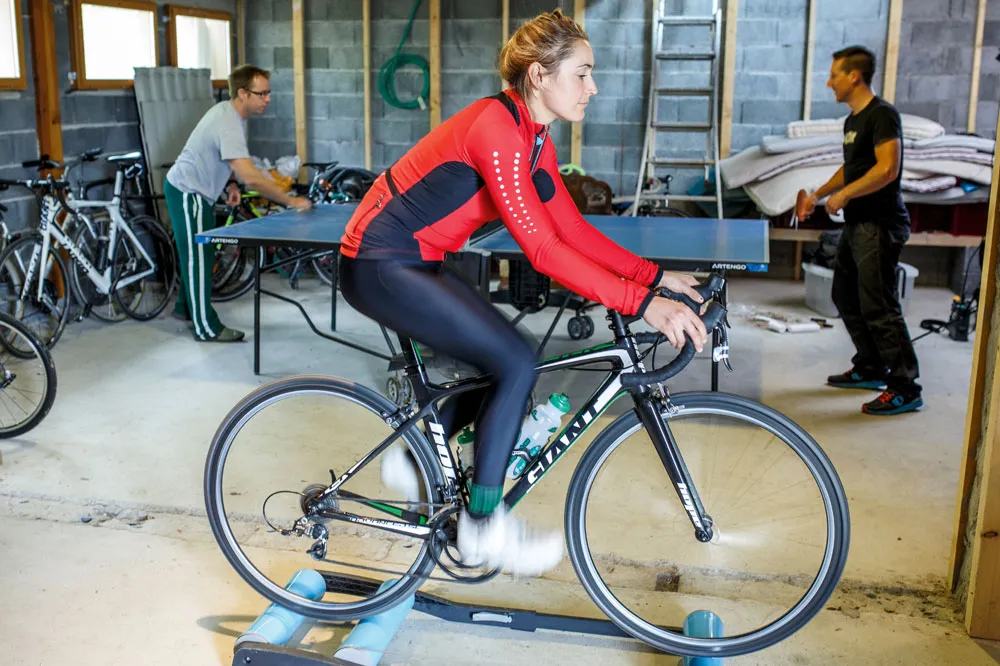
If you’re looking to buy a set of rollers for the first time and don’t want to spend too much, then the Antares model from Tacx is a great fit. In essence it’s a set of no-nonsense rollers that have all the elements you need, and none that you don’t.
At the heart of the unit are the conical shaped drums. As mentioned in the Galaxia review, these work by keeping the tyres of your bike away from the edge, gently guiding them to the center of the drum. It’s a reassuring assist for beginners and provides a much needed boost of confidence; Tacx also offers a support stand that you can pair with the Antares rollers and attach to the front wheel.
Like the previous Tacx model it retracts to a compact 80cm, and at under 17lbs or just over 7.5kg it’s light enough to transport to races should you require a method for warming up.
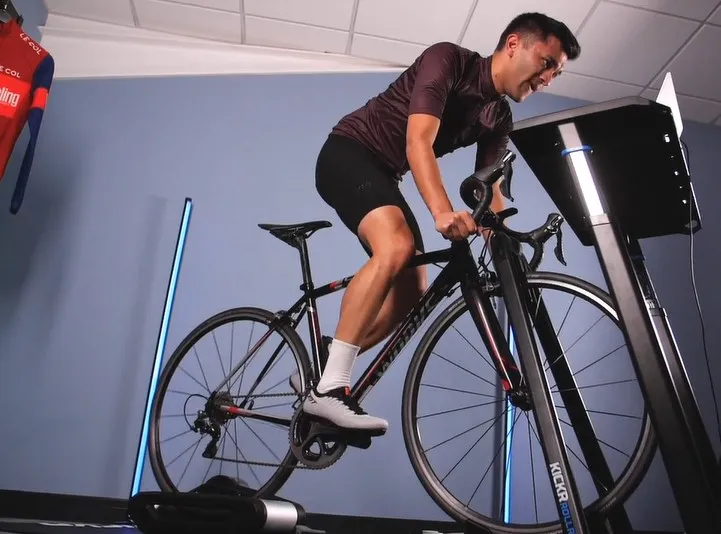
We’ve named the Wahoo Kickr Rollr as the best alternative to a turbo trainer because it offers greater stability than traditional rollers as well as the connectivity associated with smart trainers.
Let’s start with the design itself. Unlike a regular set of rollers, the Rollr uses a clamp to hold the front wheel. This instantly provides the stability assurance that isn’t there when you first take to a set of rollers. This alone makes it a good match for any beginners. The design also allows for some movement at the rear wheel, so the natural ride feel that makes the best bike rollers so appealing, isn’t lost. In short, it’s the best of both worlds, and even allowed us to get out of the saddle without any undue wheel slippage.
Its smart capabilities mean it has onboard power readings; this comes via a software update that improves on the original Rollr and means more accurate readings and thus better integration with training plans and online training apps. Other benefits include simulated gradients up to 10% and controllable resistance up to 1,500 watts.

Cyclists are often drawn to rollers because of all the trainers they offer the closest sensation to riding on the road. And when it comes to a realistic ride feel, the Elite Nero is tough to beat.
The Nero achieves this in part thanks to its floating system. Like the Galaxia model featured above it introduces some forward and backwards movement that works to absorb any sudden movements caused by a changing of pace. It’s designed to prevent you from derailing, and it works, but it also helps to create a feeling that’s more akin to riding outdoors.
This is aided further by the Nero’s smart capabilities. You get a simulated gradient of up to 7%, and a maximum of 830 watts of resistance, with both ANT+ and Bluetooth enabled so you can pair to your favoured cycling computer or indoor training app.

The roller itself aims to offer a real-life feel, thanks to the use of 'Internal Progressive Resistance'. You could use this trainer for full indoor sessions, but for us, it really shone when it came to race warm-ups and the like, helped by its surprisingly low weight of just 14lbs or 6.4kg.
Despite its lightweight nature, it uses a steel frame that offers a sturdy attachment for the fork and will accept both standard QRs and thru-axles. Its length is adjustable to match the wheelbase of your bike and ranges from 840mm / 33in to 1200mm / 47.2in. The set-up comes with a heavy-duty, padded tote bag for transport and storage.
Unsurprisingly, it does take longer to set up than the most of the other rollers in this guide, but given the degree of stability and portability it offers, we feel it’s a small price to pay.
At Cycling Weekly, our testing process revolves around our tech team entering the pain cave to sweat it out countless times every year, putting all the best Indoor training aids through their paces.
All the Rollers in this buyer's guide have been through many static kilometres and miles. Ease of setup, app connectivity, portability and stability are the key areas of focus when we test. Additionally, essential considerations include resistance levels, gradient or movement simulations, and the accuracy of the data output, which will depend on each unit's specifications, of course.
During testing, our writers will simulate a broad range of training styles and sessions, including high-intensity and maximum efforts, as well as low-intensity and recovery rides. These sessions will be repeated several times throughout testing for each Roller unit. First, determine a base and then verify the replication of data and feel.
There are plenty of rollers on the market, which can make choosing the right one for you a little daunting. To help you with your selection we’ve listed a few of the key details you might want to consider before parting with your cash.
Smart or regular rollers?
The advent of smart rollers means that you can enjoy some of the benefits of the best smart trainers with the advantages of a set of rollers. If you want to pair your rollers with a training app like Zwift or Rouvy, then going smart allows you to do this. Similarly, if you want to add greater structure to your training and require adjustable resistance and the ability to measure power then a set of smart rollers will be required.
However if you’re attracted to rollers because of their innate simplicity then staying with a regular set might be the best fit. You’ll save money in the process, while still enjoying the many benefits.
Size
Rollers have remained popular in racing circles thanks to their portability. Compared to a turbo trainer, they are lighter and more compact when retracted, which means they are easy to get in and out of a car or van. Once at the race, you can set them up quickly too, allowing you to get on with your pre-race warm up, or warm down after the race is over.
A set of the best bike rollers is a good fit for anyone who doesn't have a dedicated training space. If you need to be able to pack away your indoor set up after a session, this can be done quickly and easily with rollers. Most of them retract to under a 100cm and are slimline by design, but they do vary in size, so check the dimensions to see which best fits your needs.
Budget
Typically rollers are the most affordable of the indoor training options. While the majority of them continue to cost less than even the most basic of smart trainers, there is now a broader price range available. Essentially, this should allow you to match a set of rollers to your budget. If you have more to spend, you look at modern designs with smart capabilities, while if you’re looking for an affordable indoor trainer, then there are plenty of traditional models on the market.
Not having to attach the wheel or drivetrain means significantly fewer compatibility requirements, as setup and space are required to use rollers. This makes rollers great for pre-race warm-ups, short sessions, and those looking to do more than just pedal. It's common to see riders at all levels warming up on rollers ahead of big mountain days, Cyclocross, or Crit racing.
Turbo trainers have gained popularity in recent years, thanks to the likes of Zwift and other indoor training apps, which help reduce the monotony of indoor cycling. The realism of these units is now second to none. Those with a dedicated space, allowing for a consistent setup, are more likely to use their trainer and have higher-quality sessions.
Rollers are for more than just fitness; in fact, following a specific workout on a roller can be quite challenging, as shifting your focus from your riding to a computer or tablet can be a little tricky. However, bike rollers can help develop your bike handling, especially for those who need to hone their riding skills in tight spaces like a peloton. For training, there is also a significant overlap with turbo trainers and the best exercise bikes or indoor smart bikes.
We have a piece dedicated to this topic - rollers vs turbo trainers: which is better? With videos and advice for riding rollers from beginners to pros.
Rollers generally consist of three cylindrical drums, driven via a belt connecting two of the drums allowing them to rotate beneath your bike's wheels. Turning your spinning wheels into a static rolling road.
This is not always the case, units like the Wahoo Kickr Rollr and Feedback Sports Omnium have two small rollers supporting only the back wheel. With the front wheel held in a stand or support.
Riding Rollers can take some time to master. The technique required to balance and pedalling on the narrow rollers can be tricky, a journey that has to be done in stages. That all begins with riding between two door frames or next to a table, basically some fairly solid to grab in an emergency. Then step-by-step gradually reduce your reliance on the support as confidence grows.
Check out our handy guide on how to ride on rollers including videos and expert advice.
Completing a workout using the most basic definition of the term, Rollers offer the same ability to raise your heart rate, spin your legs and complete set workout plans as any of the best smart trainers or exercise bikes. Where we start to apply nuance is in the kind of workouts that can be completed on rollers vs turbo trainers or the best smart bikes. This is a subject we explore in far more detail in our piece on rollers vs turbo trainers.
While rollers and smart trainers differ enough to make direct comparison challenging, transportation and storage are areas where rollers have a comparable edge. The significant reason for this is their shape to start with, rollers are 'flat' in design and generally not very heavy, which makes them easy to pick up and stand against a wall, for example; many also fold or retract, making them even more compact.
Thats not always the case, of course, with units like the Wahoo Kickr Rollr, which is more comparable to a smart trainer experience; however, it does fold flat like a more traditional roller unit.
On the flip side of the coin, smart trainers pack a lot more technology, making them more accurate. Modern units, thanks to bike standards mostly shifting to thru axles and single cassette standards, have made it significantly easier to quickly fit a bike to a turbo trainer.
Pros regularly use rollers for warm-ups thanks to their ease of transportation and setup
The short answer is absolutely, yes! Of course, this depends on the individual and what works for them but rollers are still widely seen throughout the WorldTour pits and at start lines. Some do now use turbo trainers, with most Pros likely having a dedicated setup at home with one of the best turbo trainers or smart bikes. Which Is likely down to replication of data and familiarity between being at home and on the road. This all very much depends on the sponsors and affiliations teams have.
There has always been some debate over whether this is necessary or not. For most as roller sessions tend to be shorter and at lower intensity, wear is generally less and dedicated trainer tyres are not required.
There are also fundamental differences in the way a roller unit works compared to a more traditional Wheel-on turbo trainer. Your body weight is loading the tyre and making the rollers spin, just like on the road. In contrast, a wheel-on turbo trainer requires force to be applied to the wheel to replicate resistance accurately; it's this force that creates the wear.
Rollers are generally more simplistic, and faffing around with swapping tyres or having a separate bike set up ready almost defeats the object; you might as well consider a smart trainer or smart bike.
If you spend a reasonable amount of time on rollers or prefer them over a smart trainer, then it is likely to extend the life of your expensive road tyres by swapping them out for some turbo tyres.