Best bike mini pump 2026: Is manual still worth it, or just cycling masochism?
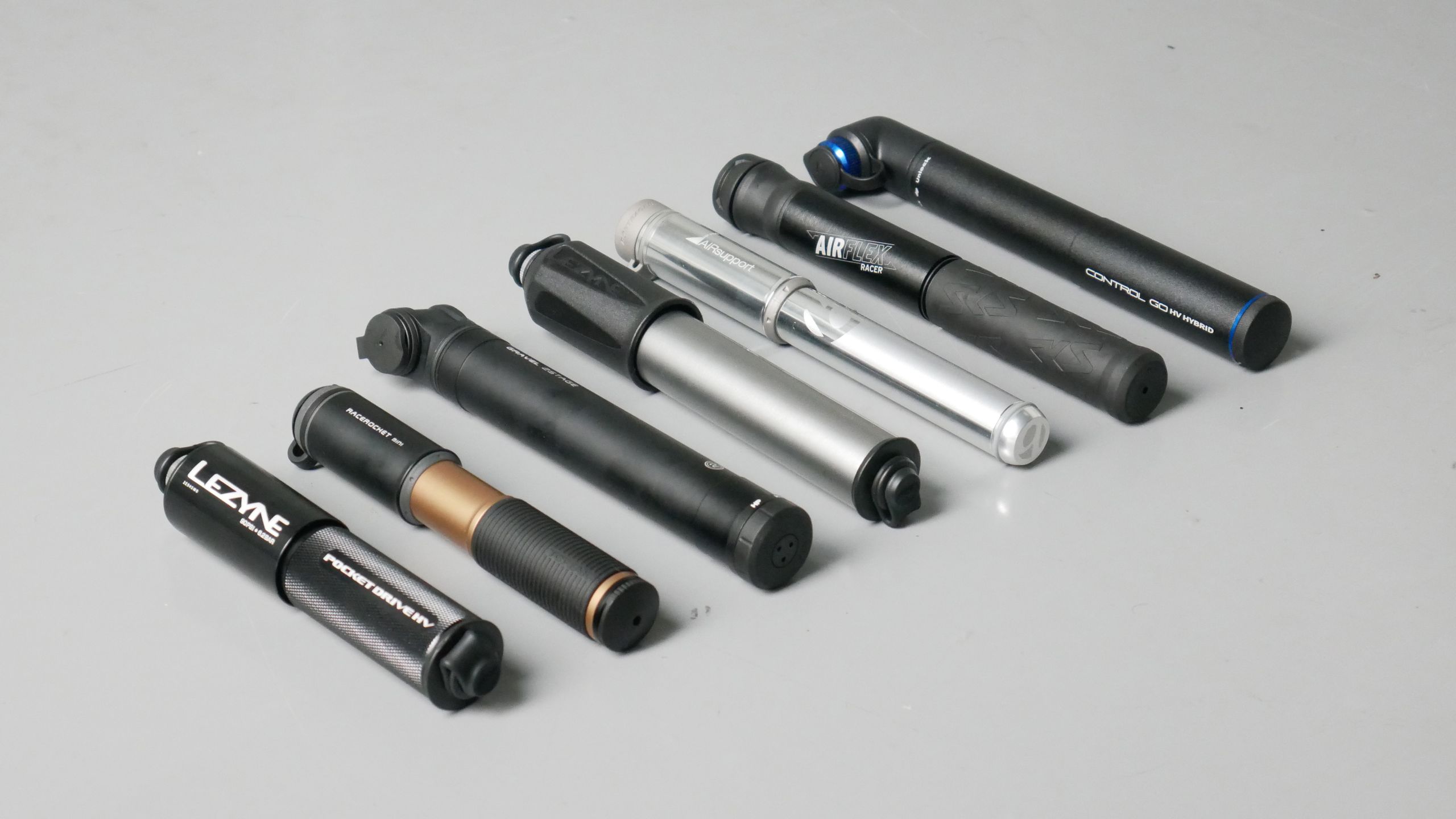
We put half a dozen mini pumps to the test to see whether they should be relegated to the relics bin or remain a reliable choice for your back pocket.
Everything is going electric, and the best bike mini pumps are another piece of cycling tech making way for electric-powered versions. I went into this group test wondering, why would anyone want a manual pump these days? Is there a lingering hint of the cycling masochism here? Perhaps. Yet the market tells us a different story.
In my testing of the best mini pump models, I didn't necessarily want the fastest, since the best electric pumps will inevitably be faster. However, I wanted to see which could actually achieve ’usable’ pressures, something I have always struggled with. For the road, my pressure target was 70 psi; for Gravel, the target was 40 psi.
By a wide margin, one pump stood out. The SKS Airflex Racer can absolutely deliver usable riding pressures; it didn't quite reach the required 70 psi, but it did deliver the highest on test, 55 psi on both our road and gravel tyres, with very little effort. Alongside a great all-round performance. What was perhaps more revealing overall is that few even came close to the 70 psi target, but that doesn't mean they're not a solid 'get-you-home' solution.
All the pumps in this guide are for popping in your bag pocket or saddle bag. For a pump to use at home, in your workshop or pre-race, check out our guide to the best floor pumps.
View Original
View Original
Our expert review:
The SKS Airflex Racer, was head and shoulders above the rest, reflected in its 4.5 stars out of 5, with its ability to inflate tyres efficiently the standout feature. What else, perhaps.
Starting with its ergonomics, it is completely unobtrusive in your hand, and the rubberised handle offers excellent grip and comfort. The best part is its incredibly light action, making it feel like you aren’t putting in much effort at all. It's in the finer details where it lost half a star, for example, the flexible hose isn’t threaded to hold it in place, and the big rubber cap didn’t stay on. Things that can be easily overlooked, thanks to its stand-out pneumatic prowess.
The Airflex is clearly a slightly higher-volume pump, as we achieved the same pressure in both road and gravel tyres at 55 psi, which is slightly low for our road target but well above the rest on test and very high for most gravel applications, and well north of our target. It also achieved these pressures in a reasonable number of strokes. 300 pumps for the road before progress becomes negligible, and 376 pumps for the gravel tyre.
View Original
View Original
Our expert review:
First impressions of the Sport Drive reminded us of those pumps we all had as kids that almost never worked, plasticky and, dare I say, cheap. Performance, however, was pleasantly surprising, and the overall value for money is exceptional.
Really, all that separates the Sport Drive from the Pocket Drive further down the page is the material the pump body is made of, yet it's separated by nearly $15 in cash outlay. I am sure long-term, the Pocket Drive body might be more durable, but given that it is all too often the internals of pumps that give up the ghost, it's worth just cashing in on the up-front saving.
The Lezyne was second in overall pumping performance, being much more efficient per stroke versus the Topeak Race Rocket in third, although it did not quite match the overall psi the Topeak achieved. For 135 pumps, the Sport Drive managed 49 psi on the road and for exactly the same pumps, 135 strokes, 28 psi in the gravel tyre. Both times, the pump got very warm and stopped forcing air through into the tube towards the end of the effort.
The Lezyne's stroke is quite short, and the plasticky handle is chunky and easy to squash and deform. This can, at times, cause the pump to catch on itself if you have a very firm grip. If you want a cheap bike pump that actually works. Niggles really. Lezyne has done a very good job here with the Sport Drive.
View Original
View Original
Our expert review:
What the Airflex gained in pumping performance, Topeak traded for superior finishing. The Race Rocket has good ergonomics, a very low weight (just 86g versus the 106g for the SKS), and the rubberised locking bung that keeps the pump together works well. Topeak has also kept the small parts to a minimum, with everything attached to the pump or well secured. It also offered a nice light action.
Unlike the Airflex, though, this light action didn’t translate into efficient pumping. After 192 strokes on our road tyre, any further strokes showed no increase in pressure; we got a maximum of 45 psi. Things looked more positive on the gravel after 217 pumps gave us 36 psi. For a light rider, these would be perfectly fine pressures to keep riding. For heavier riders, it would certainly get you home, to a bike shop, or to a cafe with a track pump.
View Original
View Original
Our expert review:
Of all the pumps on test, the Bontrager Air Support has the nicest finish. Braided hose, knurled fittings, and, aesthetically, the polished finish is timeless and classy. Where the Bontrager really struggles, though, is efficiency. Overall, pressure achieved is one of the highest on test, and in line with the Race Rocket. 37 psi on gravel and 46psi on the road.
That sounds good. Unfortunately, it took well over 500 strokes to achieve the former, and nearly 400 to achieve the latter. Given the speed at which electric pumps can achieve these pressures, this is slow, and not something you want to be doing by the side of the road, especially in bad weather or when your riding buddies are pressuring you to get on.
That said, the Air Support is super easy to use, and the push-on head helps keep things really simple. Andy did, however, find it was easy to cross-thread the hose when retracting it back into the pump body. The stiff braided hose and very short, fine, thread don't meet well every time, which could cause issues for some, though after inspection, it shouldn’t cause any actual functional issues.
View Original
View Original
Our expert review:
It's nip and tuck between the Topeak Gravel 2Stage, Race Rocket, and Bontrager Air Support. They all can achieve similar pressure, which for the Gravel 2Stage was 53 on the road and 28 on the gravel. This particular Topeak model also has the upper hand in how quickly it reaches these pressures compared to the two we rated above it.
Unfortunately, the complexity of the Gravel 2Stage detracts from its overall performance. As you can see from the numbers, the dual-chamber design (which, by turning the dial, allows for either high-volume or low-volume inflation) overcomplicated things for negligible gains. In fact, we tested it, and you can achieve the same pressures just using the high-pressure chamber and very few additional pumps. It is also the most expensive pump on test and one of the few we had with the head fitting directly onto the valve. While our test pump didn’t cause us any issues, in our experience, wiggling the valve around too much can cause damage and air loss.
View Original
View Original
Our expert review:
As I mentioned above, all that separates the Pocket Drive from the Sport Drive is the aluminium body. While this will likely mean the Pocket Drive has a little more longevity, it's largely the internals that make the pump work, and in my experience, tend to fail first. Making the Sport Drive more cost-effective up front, before you even get to the pumping performance.
The Pocket Drive just didn’t perform as well as its sibling; it is a little more efficient, thanks to its high-volume output, making it better suited to low off-road gravel pressures. However, it was nowhere near when it came to higher pressures. Scoring 30 psi on gravel for just 100 pumps and 35 psi on the road with 120 pumps.
Despite the nicer finish, the ergonomics suffer compared to the Sport Drive and the Giant item, because of how the pump actuates. It is very easy to catch your hand between the handle and the body, which we both did several times. One positive takeaway is that the CNC'd handle finish does offer significantly more grip than most on test. Great for those wet and muddy days.
View Original
View Original
Our expert review:
Giant’s Hybrid design is clearly about being one of the best CO2 inflators. Its push-on design, Presta-only head, and the fact that it comes with a cartridge and mount suggest manual pumping is a secondary feature, there for real emergencies.
That said, it has some really nice features, and while pumping performance wasn’t fantastic, the cross-compatibility certainly makes it more usable for those committing to cutting down the amount of kit they carry on a ride. For CO2-compatible pumps, this is certainly one of the better options.
Weight
Length
Value
1. SKS Airflex Racer
106g/3.7oz
19.6cm/7.7”
Presta only
2. Lezyne Sport Drive HV
98g/3.4oz
19cm/7.4”
Presta and Schrader
3. Topeak Race Rocket
86g/3oz
18cm/7”
Presta and Schrader
4. Bontrager Air Support HP Pro
106g/3.7oz
19.5cm/7.6”
Presta only
5. Topeak Gravel 2Stage
102g/3.5oz
18.4cm/7.2”
Presta only
6. Lezyne Pocket Drive HV
89g/3.3oz
14.4cm/5.7”
Presta and Schrader
7. Giant Control Go Hybrid
131g/4.6oz
20cm/7.8”
Presta only
We have a dedicated team of testers at Cycling Weekly whose job is to review a wide range of cycling products and write objective reviews based on their day-to-day experience under various conditions.
When it comes to the best bike mini pumps, our testing focused primarily on efficiency. Setting a target psi, tasked all pumps on test with hitting it, and we stopped when the increase in pressure was negligible, or impossible with the strength in our arms. We then used a Topeak tyre pressure gauge to check what psi was achieved.
We counted strokes as we pumped and compared them to the overall pressure achieved to give us a good sense of how effective a pump is. We checked this pressure each time with the ever-reliable Topeak Pressure Gauge.
During the test, I found that the number of strokes alone is too blunt a measure to call a pump good or bad. Some took far more pumps than others but delivered air efficiently. Others reached their maximum inflation capacity with little effort, whilst some took much more 'push'. Some were hard going, but did a very good job and vice versa. So look at the numbers achieved against the target, and take into account our experience of the process, alongside the other factors, before making a final decision on which to buy.
We set our targets at 70 psi for road and 40 psi for gravel. This will, of course, differ depending on your tyre size, as tyres only get bigger on both road and gravel, and the pressure many will need will drop. You may never need that much pressure. To maintain performance, even as a get-you-home solution, we would expect at least 50 psi on the road and 30 psi on gravel to be a sensible expectation.
We also considered other factors, including chuck design, ease of use, weight, stability, and how easy they are to carry on a ride.
For more information about our testers and how the team here at Cycling Weekly tests products, visit our How We Test page.
Like so many others, Matt began his journey in his local bike shop before seizing the opportunity to become an award-winning E-bike designer. This means that for over 15 years, Matt has been wielding tools, including the occasional hammer, whether assembling and repairing bikes for customers or working out the intricacies of his latest prototype.
Andy Carr is our tech editor here at Cycling Weekly. He was the founder of Spoon Customs, where, for ten years, he and his team designed and built some of the world's most coveted custom bikes. The company also created Gun Control Custom Paint. Together, the brands championed the highest standards in fit, fabrication and finishing. From welding to painting, repairing and assembling, Andy has done it all.
Road - 70 psi target
Gravel - 40 psi target
1. SKS Airflex Racer
55 psi from 300 strokes
55 psi from 376 strokes
2. Lezyne Sport Drive HV
49 psi from 135 strokes
28 psi from 135 strokes
3. Topeak Race Rocket
45 psi from 192 strokes
36 psi from 217 strokes
4. Bontrager Air Support HP Pro
46 psi from 365 strokes
37 psi from 550 strokes
5. Topeak Gravel 2Stage
53 psi from 250 strokes
28 psi from 300 strokes
6. Lezyne Pocket Drive HV
35 psi from 120 pumps
30 psi from 100 pumps
7. Giant Control Go Hybrid
36 psi from 95 pumps
18 psi from 76 pumps
It won’t surprise you that Andy and I still believe the future belongs to the best electric bike pumps. Our testing hasn't changed that reality. As much as we both enjoy keeping things analogue, there is no denying that electric pumps are faster, lighter, and more compact, and that is what I personally carry in my back pocket or bag now.
The only real "barrier" to electric pumps is the need to charge them, and even that argument is thinning. Most of us wouldn't dream of leaving the house without a charged phone, best bike computer, or electronic groupset. Adding a pump to that charging routine isn't the hurdle it used to be.
For some, the fact that another thing has to be charged before a ride, and the psychological and practical difficulties that entails, will keep the manual pump trade going for years to come. And we're pleased to report that the manual pump clearly isn't a relic just yet. There are some capable, really great options for those who want to keep it analogue, especially if you want one of the best floor pumps.
While electric pumps are improving, the smallest units often provide only 2 or 3 inflations per charge. If you’re facing a multi-puncture day or heading a little further afield, especially given the trend within the sport to ultra-endurance events like the Trans-Continental, GB Divide or Unbound XL, "two or three tyres" might not be enough.
In the world of bikepacking and long-distance cycling, reliability and infinite capacity are the only currencies that matter. That is why the best bike mini pumps remain essential tools in your arsenal. They will never run out of charge; they don't care about the conditions, and they’ll work every single time you pull them out of your pocket.
Fundamentally, there are three ways to inflate your bike tyres on the road or trail:
Mini pump - The best portable bike pump will balance the ability to inflate your rubber with being small enough to carry in your rear pocket or stow on the frame. Your riding priorities will help you focus your decision here, as, like all bike pumps, each one will lean towards a specific talent, e.g., micro size and weight, but not great at achieving much more than getting you home, tyre pressure, or great PSI capabilities, but heavier and frame-mounted.
CO2 Inflator - Technically, this isn't a pump as it contains compressed gas, which can reach up to 120psi in seconds. There are pros and cons to this system, more of which are explained in detail on our page dedicated to the best CO2 inflators.
Electric Pumps - the best electric bike pumps are taking over, replacing both mini pumps and CO2 inflators for many. I have even heard of some riders ditching their floor pumps, too, but I think we might be getting ahead of ourselves there. There isn't much more to say, really; they are just a very compact version of your car tyre, an air mattress or a paddleboard pump. Which, providing you keep it charged, is as simple as turning it on, placing it on the valve and letting it do the heavy lifting.
A mini pump is a small, portable pump designed to be carried with you on your rides. Sizes do vary - some are small enough to fit in a pocket or saddle bag, whilst others might need to be frame-mounted. This portability comes at a cost, though, and they are not the most efficient way to inflate a tyre, so they are primarily for emergency use if you suffer a puncture away from home.
A good mini pump should be able to inflate a road tyre to 50 or 60 psi (enough to get you home) without too much trauma, but be prepared to be pumping for a while, as their diminutive size means that not much air is being moved with each stroke. Typically, a mini pump will take several hundred strokes to reach a reasonable pressure.
Some mini pumps attach directly to the valve, whilst others include a hose to make life a bit easier, and most will work with both Presta and Schrader valves by swapping the head about. Integrated pressure gauges are definitely not an essential element of a mini pump, although some do include them, so don’t worry if a pump doesn’t have one.
Size, weight and efficiency are the three main elements to consider, along with your particular use case.
Racers and riders who don't venture too far from home will probably opt for the smallest pump available, since they don't expect to use it much. Bikepackers and long-distance tourers, on the other hand, might prefer to sacrifice some compactness for greater efficiency and ease of use, since the pump is more likely to see action and less likely to be near a convenient bike shop or taxi if the worst happens.
From our testing and experience, while the pump's main function is always the primary focus, there are other smaller details worth keeping in mind that could even affect your choice before purchasing.
The main one will be the valve you can use with that pump. Many now only offer Presta compatibility, so especially if you ride a lot as a family where multiple valve types are more common, thats worth considering.
Otherwise, there is, of course, how it fits with the value and where you might store the pump. Most of the pumps we tested feature a flexible hose, which is gentler on valves, helps prevent unwanted damage and air leaks, but adds complications.
Equally, if you don't wear cycling-specific clothing or prefer to fix the pump to your bike, how it does that and its flexibility are key considerations.
It is sound advice to always carry a mini pump with you, even if you also carry and use CO2 cartridges. Most experienced cyclists have experienced the frustration of a double puncture, induced by a nasty pothole or freshly cut hedge, and a CO2 cartridge can only pump up one tyre. It can also be very easy to not attach your inflator correctly to the valve, and lose all the CO2 without getting any in your tyre.
If you are striving for a KOM or personal record and are sure that back-up is available, then by all means ride with just CO2, but when some of the pumps on test weigh a scant 65g we would suggest that it is always worth sticking one in your pocket.
It is also less wasteful and cheaper to use a pump in the long run. However, the trend really is to replace both with one of the best electric bike pumps. They offer greater sustainability, high reliability, and are just as compact and easy to carry.
Most mini pumps come with clips to attach the pump to the frame, or, if it is small enough then the pump can go in a pocket, saddlebag or tool tub.
Carrying it in a pocket is the simplest solution, but it takes up space, might get forgotten and can get wet/dirty, particularly off-road. Similarly, if you use the bottle cage mounts, the pump will be exposed to all the spray and mud from the road or trail which might cause damage in the long term, but as it is on the bike it won't get left at home and is easy to get to. If you do use on-frame mounts, then it's worth ensuring that the pump's head is turned away from the direction any muck is likely to come from so it stays clean.
This leaves my personal preference, which is to keep the pump in a saddle bag or tool tub - out of harm's way but accessible and always with the bike. This option does require a pump that is small enough or a bag that is big enough to make this work.
Having a gauge is definitely helpful for setting up tubeless tyres and optimising performance; however, it's not always available. With hand pumps, for example, it's not always an option; in fact, to make them more compact, it's far more common not to have one. The Best floor pumps should have a gauge.
Having a gauge has become more of a necessity than ever, as Hookless rims have become widespread. It is hugely important not to exceed the maximum tyre pressure, which for many is 72psi. If you run a hookless rim or even a standard hooked rim with a tubeless setup, there are tyre pressure considerations you must stick to and not exceed. If your pump doesn't have a gauge, I would recommend grabbing a pressure gauge, like the Topeak D2 Smart Gauge. Given our testing here, you are unlikely to reach these maximum pressures on the road or trail with a hand pump, so that's less of a concern.
If you need help with the pressure your tyres should be at, consider checking out the many tyre pressure calculators available.