Best budget cycling helmets 2026: comfort and protection without the cost, all expert-tested
We are constantly in pursuit of great and affordable cycling gear. In this guide, you can find six budget helmets we rate highly for road, gravel and commuting
Budget and safety aren't words you normally want to hear in the same breath, with questions inevitably raised about where corners have been cut. This is a misconception about bicycle helmets: the best budget cycling helmets are just as safe as those with a more premium price tag, thanks to strict bicycle helmet safety standards regardless of price.
So, why are bike helmets so expensive and why doesn't everyone just wear a budget one? While basic safety levels are met, even with a large number of budget helmets now featuring MIPS or other rotational impact systems, it really boils down to this: the lighter and more aerodynamic a helmet is, the more you spend.
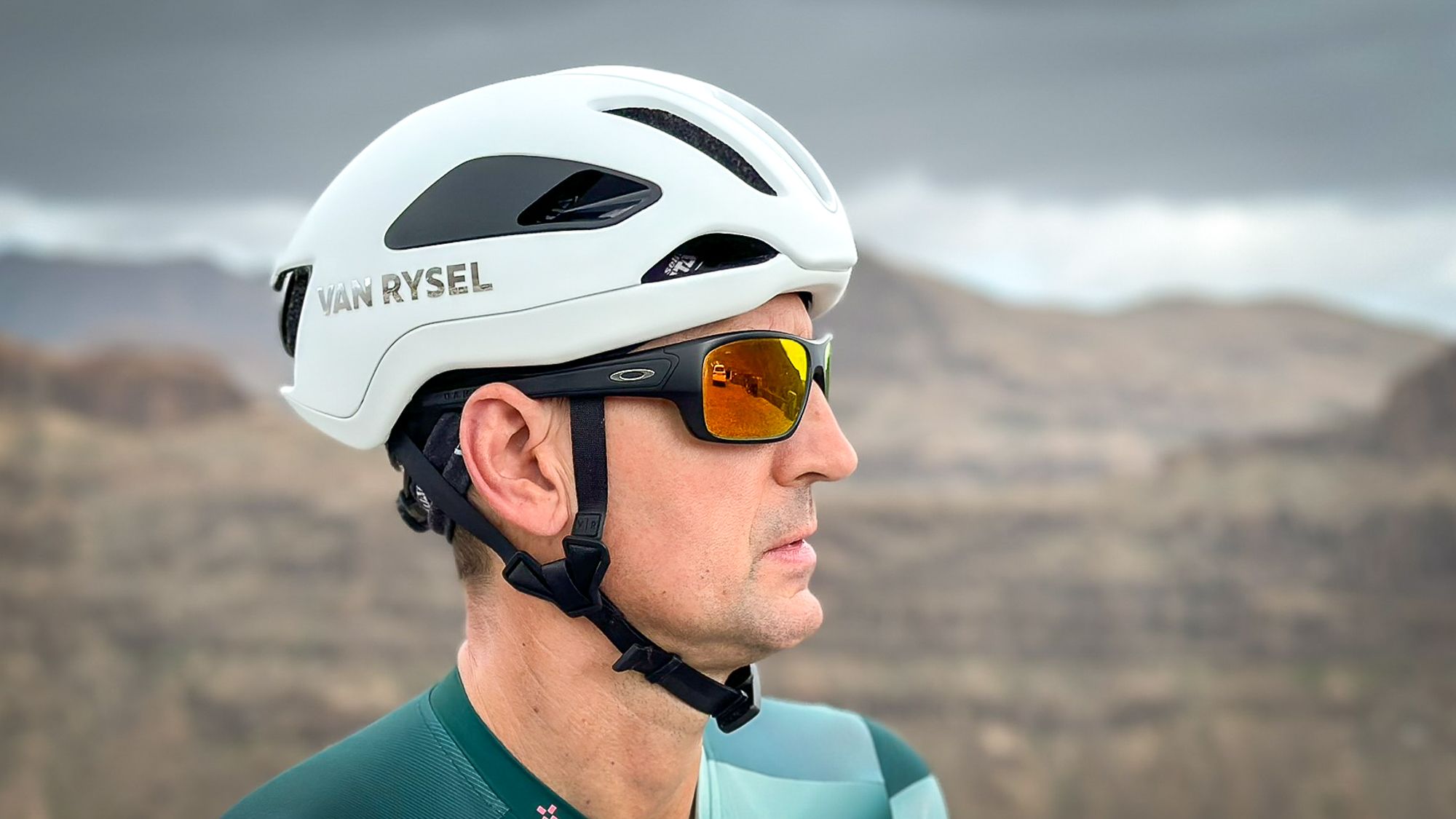
Now, if those things aren't high on your hit list, then check out these six helmets, all ridden and reviewed by our experts. Selected for their performance versus price, they all represent value for money and excel in specific areas, such as ventilation or comfort. Our experts awarded the best overall to the Van Rysel RCR MIPS for its astonishing value and performance, as the most affordable helmet used in the pro peloton. It's likely also one of the best road bike helmets we have ever tested.

Our expert review:
Reviewed by James Shrubsall - CW News & Features Writer
The RCR MIPS is yet another brilliant bit of kit from Decathlon's in-house brand Van Rysel that works the price-performance ratio hard. Ridden to many glories by the Decathlon team over the last few seasons alongside its namesake, one of the most affordable bikes in the peloton, the Van Rysel RCR Pro.
It is hard to review something like the RCR MIPS without constantly having the price in the back of your head. Every time I thought of even the slightest niggle, I had to think, yes, but it's under $100. For example, the shape of the RCR is a little rounder than some higher-end helmets, but that depends a lot on your head shape and what you find comfortable, which is entirely subjective. I also thought that while the helmet is incredibly well-ventilated for those who live in cooler climates like myself here in the UK, it could almost be too well-ventilated.
Again, I had to pinch myself about the price and just how much value and performance there is in this helmet for such a low price.
The best part is that even if you can't stretch to the MIPS version, for $20 less you can grab the non-MIPS-equipped version, which packs all the same performance without the crash safety structure.
Read James's full Van Rysel RCR MIPS helmet review

Our expert review:
Reviewed by Paul Grele - CW Tech Contributor
From a distance, the Align II looks like any other Specialized helmet, with premium looks that are far beyond what its price suggests. It uses the brand's tried-and-tested Trifix straps and Headset cradle adjustment. Combined with a CE-approved polystyrene shell, it comes in at 357g for my medium/large test helmet.
What sets the Align II apart from its very popular predecessor, arguably the original best budget helmet, aside from a more road-style design, is the inclusion of the Multi-directional Impact Protection System, or MIPS for short. This is a system that has become an expectation for most high-end lids; however, it is still sparsely used on more affordable cranial cradlers. So, for Specialized to have got this lid under $70/£50 is quite incredible.
What is even more incredible is that I've always struggled to find helmets that fit my head shape, but the Align II felt comfortable from the first ride. There was no movement, with no tight or loose spots, making it very comfy! And a pleased Paul!
What this extra protection does, though, is limit the ventilation. On a 20-degree day with around 50% humidity, the Align II starts to feel a little hot, and spending up to the larger vented Loma might be worthwhile. That said, for those who aren't putting in such intense efforts like commuting or riding in cooler temps, it could be ideal.
What the Align does is remove any excuses for not wearing a helmet. At these prices, with the level of safety built in, it really is a no-brainer.
Read Paul's full Specialized Align II bike helmet review

Our expert review:
Reviewed by Tim Russon - CW tech contributor
The RCR-F is likely the least expensive helmet in the pro peloton right now, adorned by the riders of the Decathlon CMA CGM team, significantly undercutting not just top-end helmets but many brands' value-oriented offerings.
The RCR-F MIPS Helmet features an elongated profile, as do many aero helmets, and fewer than ‘standard’ vents. There are five vents, with two on the sides to hold your best cycling sunglasses. There is a plastic yoke to hold and separate the straps neatly, and a Fidlock-operated chin strap, which I must embarrassingly admit took me a while to work out.
I’m in no position to test the helmet’s aero or safety credentials, but the VR comes EN1078-approved, although the brand is yet to put any of their helmets through the Virginia Tech standard. Aerodynamically, given it's used by the Decathlon CMA CGM team and developed by SwissSide, it is safe to assume it isn’t too draggy.VR claims a saving of 3.4 watts compared to the RCR-R at 45 km/h.
Ultimately, the RCR-F is a very reasonably priced, good-looking and comfortable helmet that should confer some aerodynamic gains, alongside being well ventilated in a variety of scenarios. However, I'm left thinking that the much cheaper RCR, which is the best overall in this guide, might just be the better option, for even less money.

Our expert review:
Reviewed by Emma Silversides - CW tech contributor
Cannondale are well established as a bike manufacturer. But they're fairly new to the helmet market. Naturally, we were eager to test the brand's helmets...
The Cannondale Junction is a stylishly designed lid with two-way adjustment and a simple but effective strap arrangement.
Cannondale currently only offer two different sizes, S/M and L/XL, so those at the extremes might be left wanting. If you fall into the average category, you should appreciate a snug-fitting helmet with the added protection of MIPS.
The helmet's well-suited to a variety of riding, making it a great option if you commute as well as ride for pleasure, on or off-road.
It probably won't be appreciated by racers, as the MIPS shell works against the airflow channels somewhat when it comes to ventilation. Our tester felt that this was only really an issue for prolonged, intense efforts.
Read Emma's full Cannondale Junction bike helmet review

Our expert review:
Reviewed by Simon Fellows - CW tech contributor
On the face of it, the Estro Wander is little more than a marketing exercise. This helmet refresh is the equivalent of striding out with some new powder-soft matt lippy while clutching a fresh designer handbag. And, there is nothing wrong with that. The current version of the Estro has been around since 2021 and, admirably, has fulfilled its remit as a mid-priced, lightweight, multi-purpose road, cross and gravel helmet.
Ventilation is ample, with 26 vents in total: 17 inlets and nine exhaust ports clustered at the rear of the helmet. This is one airy lid. Met equips the Estro with MIPS (Multi-directional Impact Protection), albeit the less premium, less integrated MIPS-C2 version.
Retention is courtesy of Met’s well-regarded Safe-T Upsilon system, which provided a comfortable and secure fit. Far too often I fall between a Medium and Large size. However, the Safe-T Upsilon retention system on the large sample helmet proved comfortable and secure.
For better or worse, aesthetics influence helmet purchase decisions enormously. Are we likely to buy a safe, comfy helmet that doesn’t look the part? Probably not. In this respect, the Estro Wander scores highly.
Ventilation is frankly superb. Honestly, the Estro competes with some of the best in the market here, and it's up against stiff competition like my preferred Lazer Z1 helmet. One of my pet peeves is riding glasses rattling on the helmet shell, but I need not have worried. Although the Estro does sit comparatively low around its entire circumference, it doesn’t interfere with my line of sight or my oversized Rudy Project Kelion riding glasses. Which also could be docked in the lower front vents.
Read Simon's full Met Estro Wander Helmet Review

Our expert review:
Reviewed by Tyler Boucher - CW tech contributor
The Cielo takes inspiration from the now iconic Aeon; while it may take its design cues from back then, it is a thoroughly modern helmet. Featuring 22 vents, internal ventilation channelling, and a MIPS Evolve Core liner, Giro's Roc Loc 5 Air retention system, and padding that contains silver particles to prevent odour. There is a lot going on inside this helmet.
The only thing that is really missing is that it has yet to be tested by Virginia Tech’s independent testing lab; historically, Giro has performed well in this testing, though.
Fit is the most important part of any bike helmet, and Giro helmets tend to fit oval head shapes better. I’ve also found in the past that different models do fit slightly differently. This is not so much a critique of Giro as other helmet makers suffer the same frustration.
The Cielo on test, though, feels very comfortable, especially across the forehead and in a range of temperatures, and the Roc Loc retention is so easy to operate. Giro straps do sit close to your head, which gives the air of security but works for comfort and aerodynamics as well. It’s worth noting that Giro makes no specific claims regarding aerodynamics, but that's not to say they haven't been considered. There is also plenty of room for a casquette or cap if you want.
The only real significant shortcoming is the near 300g/10.5oz weight. 295g/10.4oz to be precise. This is in contrast to the Aeon it replaces, which, while a decade old, was known for its featherweight. The trade-off and much of this gain is down to the MIPS system, so you are at least getting a much safer helmet.
Read Tyler's full Giro Cielo helmet review
After cutting his teeth on local and national newspapers, James began at Cycling Weekly as a sub-editor in 2000 when the current office was literally all fields. Eventually becoming chief sub-editor, in 2016 he switched to the job of full-time writer, and covers news, racing and features.
He has worked at a variety of races, from the Classics to the Giro d'Italia – and this year will be his seventh Tour de France.
A lifelong cyclist and cycling fan, James's racing days (and most of his fitness) are now behind him. But he still rides regularly, both on the road and on the gravelly stuff.
Simon spent his childhood living just a stone’s throw from the foot of Box Hill, so it’s no surprise he acquired a passion for cycling from an early age. He’s still drawn to hilly places, having cycled, climbed or skied his way across the Alps, Pyrenees, Andes, Atlas Mountains and the Watkins Range in the Arctic.
Simon now writes for Cycling Weekly as a freelancer, having previously served as Tech Editor. He’s also an advanced (RYT 500) yoga teacher, which further fuels his fascination for the relationship between performance and recovery.
Tyler Boucher is a former (and occasionally still) bike racer across several disciplines. These days, he spends most of his time in the saddle piloting his children around in a cargo bike. His writing has appeared in magazines published in Europe, the UK and North America. He lives in Seattle, Washington.
Tim Russon is a writer and photographer who has worked in the outdoor and cycling industry for over 20 years. He can’t remember a time when he didn’t own a bike and has road, gravel, mountain and retro bikes in the shed. His favourite place to ride is the Dolomites, a simply stunning area which has breathtaking views and incredible roads combined with lovely food and great wine.
He prefers long, hot climbs in the big mountains, but as he lives on the edge of the Peak District, he has to make do with short, cold climbs most of the time instead.
The team here at Cycling Weekly takes helmet testing very seriously. While, of course, we would all like them to enhance our performance, ultimately, helmets are there for our safety and protection. Although we don't have the facilities to conduct safety testing ourselves, several independent testing facilities do. The most notable and recognised is Virginia Tech, which has developed a bike helmet safety rating. If a particular helmet tested by our reviewers scores highly on this scale, we certainly consider that in our overall evaluation.
Outside safety, our reviewers typically spend several months testing each helmet. This allows us to assess performance in a variety of conditions, temperatures, and intensities, providing a comprehensive overview. Ultimately, the most important aspect for many is comfort; however, this is subjective and varies based on individual preferences and head shape. We aim to give a fair and thorough perspective on each helmet's comfort by examining factors such as strap and buckle positioning, weight, ventilation at different intensities, and padding placement.
Finally, as with all products we review at Cycling Weekly, a helmet's overall value is judged relative to its category and main competitors. We also endeavour to make fair comparisons across other categories to offer honest advice on choosing a new helmet. This assessment considers its overall performance, price, and market position. While these are our primary focus areas during helmet testing, they may vary slightly depending on the reviewer and the category the helmet is aimed at.
For more details on how we test here at Cycling Weekly, visit our How We Test page.
Fit is the most tricky part of any helmet. Everyone’s head is a different shape, so fitting it into an object with fixed dimensions is always going to be tricky.
There’s some adjustment in all helmets for head circumference and height, while padding and hair help to cushion any tight spots. But no helmet will fit everyone perfectly, so try before you buy is the best advice to ensure comfort.
Look out for areas that might put pressure on your scalp - that might feel okay in a shop, but get uncomfortable after several hours of riding. Also make sure that the helmet sits securely and doesn't wobble about front to back or side to side.
Short for Multi-directional Impact Protection System, MIPS was developed by a Swedish company. It provides a smooth inner layer that’s loosely connected to the helmet’s shell and slides between the helmet and the head in the event of a crash.
Helmets with MIPS consistently come towards the top of independent helmet impact tests, but the technology adds to the price of your helmet and ups weight by around 10 to 15 grams relative to an equivalent non-MIPS helmet. Read more about MIPS helmets here.
Air circulation is important for riding comfort, particularly on a hot day. More vents tend to be better for cooling, although internal channelling helps to push air over the head too. The modern trend to aero helmets works the other way though, as airflow over the helmet shell is usually better with a smoother profile, reducing drag. This piece looks at the aero benefits of an aero helmet.
So it’s worth considering how important aerodynamics and fast riding are for you. If you’re just after the best cooling airflow, more or larger vents are better, whereas if you want to go faster, you might want to look for a more enclosed design. The pros often swap between more and less vented helmets for mountain and flat stages and some helmets let you open or close vents to suit the ride conditions.
A helmet will come with adjustment to tighten it around the circumference of your head for a secure fit, called a retention system or fit system. That’s usually achieved via a dial adjuster at the rear of the helmet’s inner cradle, but Lazer puts its adjuster on top of the helmet shell.
You can also adjust the cradle up and down by sliding it in and out of the rear of the helmet, so that it sits below the back of your skull. Some systems work better than others and we’ve noted any issues we found while testing in the reviews of each helmet.
Straps too are adjustable for fit under the chin. Many helmets allow you to alter the position of where the two side straps meet under your ears too, although some don’t. Ideally, straps should meet just below the ear for a secure fit. Most close with a plastic snap catch.
Helmet weight varies greatly, with some helmets much weightier than others. That’s not usually so noticeable once you’re riding, but you might find a lighter helmet more comfortable.
It’s something that is of concern to a pro, but probably not so important to leisure riders. MIPS will add a few grams to helmet weight too and cheaper helmets in general tend to be heavier than their more expensive peers, although there are exceptions.
Don't continue to use your helmet if it's been involved in a ding or even if it's been dropped, as it might have been weakened and not protect you effectively.
Many helmet makers offer a crash replacement program, which lets you buy a new helmet at a reduced price if you’re involved in an accident. Terms vary by manufacturer, but it’s a bonus service worth looking for.